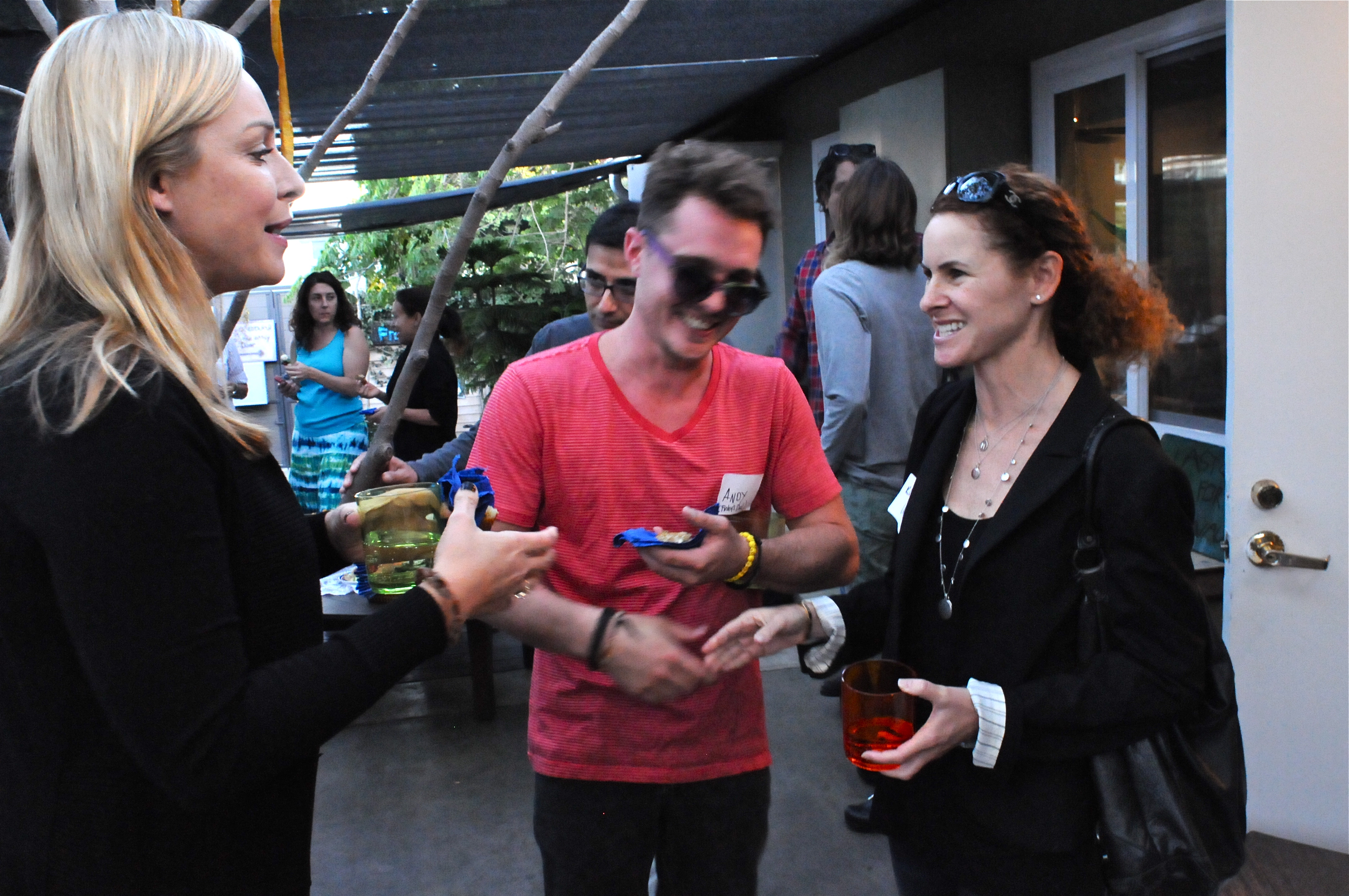
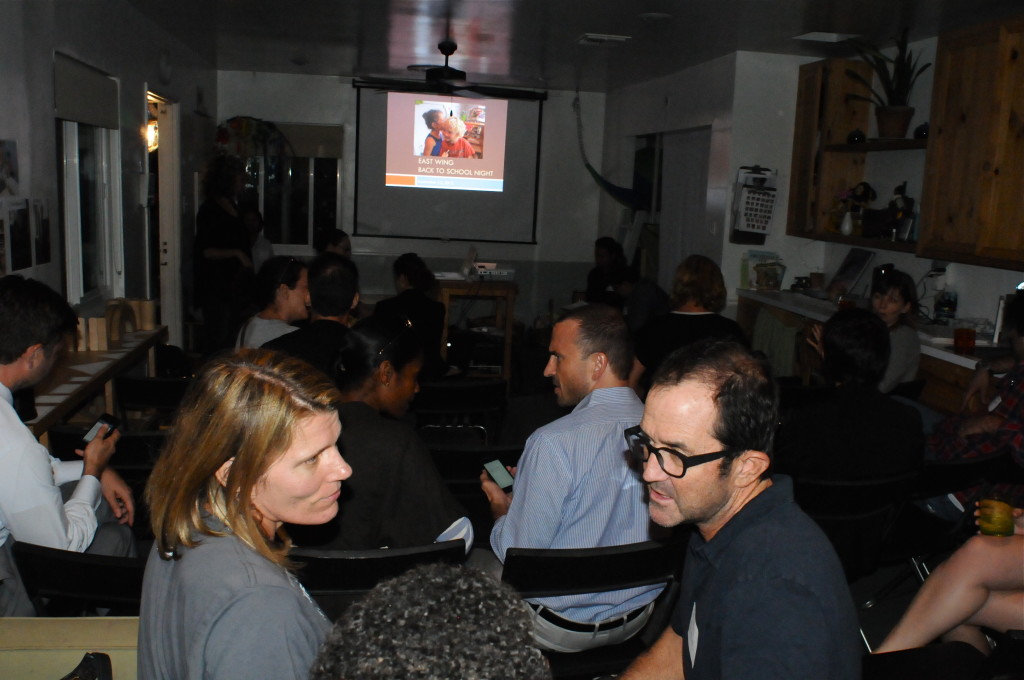
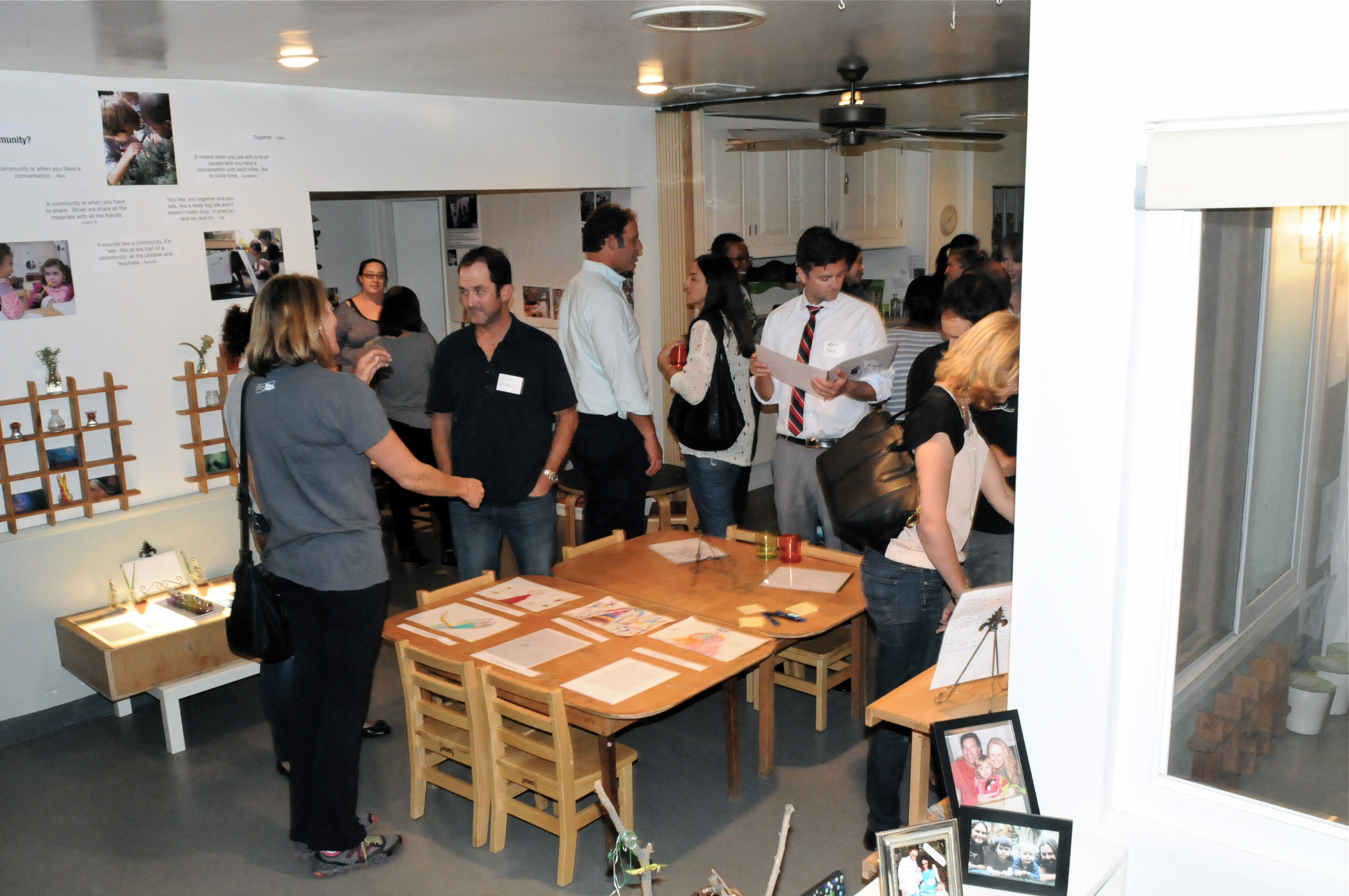
Step 1: schmoozeStep 2: inspiring presentationStep 3: talk with the teachers in the children’s favorite spaces.East Wing Back to School Night
September 12, 2013
Notes taken by Joy (Maddie’s mom)
Roleen: Welcome
First, welcome to our new family, Noa Spector’s family. Her parents, Daleet and Todd, are here tonight. Noa will be here full-time and we’re happy they’ve joined us.
Many parents on the East Wing are interested in knowing how we are preparing their children for kindergarten. You know they’re having fun but now you may be asking, “What are they going to teach them?” Because our memories of school are different than what we see happening at NSW, you may be wondering how the teachers are marking the children’s progress. If there are no workbooks and formalized “instruction”, how will we know our children will be ready for kindergarten? Roleen spoke of the importance of learning that comes from context and connections. That learning only happens when children are interested. That writing happens because children want to communicate something. Counting, patterns, color recognition, etc., happens naturally because children are classifying and putting things in order that makes sense to them in their play, in their world. It no longer makes sense to teach letter and number writing in isolation. Our focus for the last couple years has been to look deeper at the 7 essential life skills that is reflected in the Mind in the Making book by Ellen Galinsky (November 5th at NSW). Tonight’s presentation will reflect their importance as you’ll see with the teachers’ presentations of the children’s work. For our own learning, we have referenced the Core Standards for Kindergarten and the DRDP (Desired Results Developmental Profile) assessment forms. Not surprised, we discovered that we are “blowing the tests out of the water!” Roleen stressed the importance of giving children what they have a right to have now and not put so much focus on teaching them things they’re supposed to know in their future. She used the example that in 10 years she may need to use a walker. She’s not practicing now! The same is true for our children. They will learn how to read, use negative numbers, etc. when they are ready for those challenges. We need to meet them where they are at this developmental stage.
Amy: Intention
“What we teachers want to see this year”
This classroom will grow to honor and empathize with individual perspectives in order to develop a lasting sensitivity that impacts future generations in its legacy.
Flora: Critical Thinking
Spaces are set up to develop children’s interests. The mini-studio is like the indoor garden, so that the ideas from the outdoor garden can continue to grow inside. For example, Nico and Eden, working at the garden table, made pictures with seeds. They discussed the seeds having “big information.” [“Information” inside the seed to make the plant.] They took this discussion to the reflection meeting and the larger group was asked, “How do seeds communicate?” After many responses, one response summed it up:
“Seeds are powerful because they make plants. Just because they are small doesn’t mean they are not powerful.”
We see the seeds as a metaphor for the children.
By cultivating the children’s own curiosities and interests, we develop the kindergarten DRDPs, such as memory, knowledge, and cause and effect.
Through nurturing and cultivating the life cycles in the garden, will the children transfer the empathy that they are developing into their peer relationships?
Melanie & Katherine: Math and Science
We are the front yard teachers.
We set up a provocation with leaves and magnifying glasses in the front yard on a table. Maddie and Arabelle worked at a table, Maddie examined the leaf with the magnifying glass and Arabelle drew a leaf. Later that day, Maddie dipped her hands in paint and stamped them on the paper and made the connection, “We have lines in our hands like the leaves.” This provocation with the leaves continued with Maddie and Bennett working with clay and Maddie creating a windy island with leaves blowing on the ground like they do at NSW. Finley and Arabelle debated the seasons: Finley said it was Fall, Arabelle said it was Summer.
The teachers will be continuing to develop the children’s natural interest in leaves and Fall and use that to develop math ideas, such as volume and the passage of time. They will soon be the collecting leaves that fall in the front yard, and measuring the volume of how many are collected from the outdoor space on a daily, weekly, and monthly basis. The children will introduce clear tubes to compare the volumes, measure and mark the passage of time.
Parents: We [the teachers] need a large piece of clear vinyl to create a very large “tube” where they can keep all of the leaves collected. We will use marker on the tube to label the passage of time and volume.
Silvana: Storytelling
Last year, the children mostly told their stories to the teachers, maybe because we were the ones writing them down. But this year, we want the children to share their stories with each other. The idea is to help them learn to empathize. After the children share their stories, they draw them, and then act them out.
For example, Tal, Deia, Maeve, Lucy R. and Desmond brainstormed a story about princesses, then they drew it out. Desmond decided to be a dragon fighter. When it came time to act out a scene, Desmond was using a pink scarf that Lucy R. wanted for the princess. Using the story as their anchor, Lucy R. agreed with Desmond that the scarf was needed to catch the dragon, and the children were able to negotiate the conflict.
Adriana: The Building Space
The children were asked about what things they wanted to bring from the West Wing to the East Wing. They wanted to bring their characters with them, such as Abiyoyo and the Robot.
One of the many goals is to have the children go from “this is mine” to “this is our idea.”
In the building space, Brooks, Danny, Gus, Noah, and Taj worked on expressing the “fear” emotion. They decided to build “Scary Town.” They built and drew traps, fires, vampires and a freeway (Maeve’s addition). When asked why a freeway was scary, Maeve pointed out it is scary to stand above one and look down, and when the cars go by so fast. Merek and Danny added a racetrack with an overpass so the cars could go fast and high up. The children use real tools to draw pictures of their ideas—rulers, compasses—in the context as they need them, not just because the teacher says “today we are going to use rulers.” There is lots of writing, too. They want to make signs for scary town. Now they are concerned that they write signs but do not know how to read them. So we are working on ways for them to read them.
Go and see the East Wing spaces. Read the blog online and the printouts in the classroom.
Reflections from the Parents:
I remember earlier this summer we had a bunch of little ones over for a play date. I was playing with a little girl named Lulu. She was asking me to say a letter, and then she proceeded to write out each letter meticulously. Her print was better than Andy’s. I threw her some softballs: T’s, M’s, and U’s. Then, I started spouting out the more random letters: k, j, and even a v. She nailed every letter. My heart skipped one or two beats and my belly fluttered just a tad. I think I said, “Oh crap” out loud. Did Dot know her letters? Will Dot be able to read??? Will she love The Brothers Karamazov as much as I do some day? I got a little panicked. Maybe even scared. I then wondered immediately, “What’s Dot doing right now?” I looked out to our backyard, and there she was swinging on our geo-dome: upside down, clearly trying to bite her own hair with her mouth over and over again. I LOL’ed. It was a delightful wakeup call to not fret. She was doing exactly what she should be doing. Playing.
Me. Ms. Progressive Educator herself got sucked into the fear factor-race-to-nowhere mindset. In seeing the glory of her swinging upside down trying to propel a mouthful of her own hair into her mouth, I found my grounding. I relaxed. I was reminded that her job is to learn how to play, how to share, how to listen and love, how to communicate her perspective, and how to value others’ perspectives. Her job is to be free to be herself.
What the East Wing Back to School Night did for me was contextualize even more the value of play, exploration, and all things Reggio. I loved learning (and re-learning) that through play, student choice, and reflection, our little ones are learning how to think and act critically and empathically. Getting the opportunity to listen to all of Dot’s teachers and Roleen, I re-found my grounding again. And I found a renewed sense of peace and gratitude, for the incredible, incredible preschool community Dot and our family get to be a part of. Melinda (Dot’s mom)
One cool thing: it provided all these explanations as to why Tal has been talking about the things she has: almost every conversation we’ve had over the past couple of weeks related to something that the teachers revealed to us that the kids were experiencing at school.(Steph and Shelley, Tal’s parents)
The evening was lovely. I loved the teachers being so available for conversation and questions. I am always so impressed by the depth of knowledge and insight our teachers have regarding curriculum and child development.
I was curious about the gender divide. (ie, mostly girls in dramatic play and mostly boys in the building area). Maybe it was just a snapshot, but I’m curious if there are ever any conversations about gender stereotypes.
(Sarah, Henry’s mom)