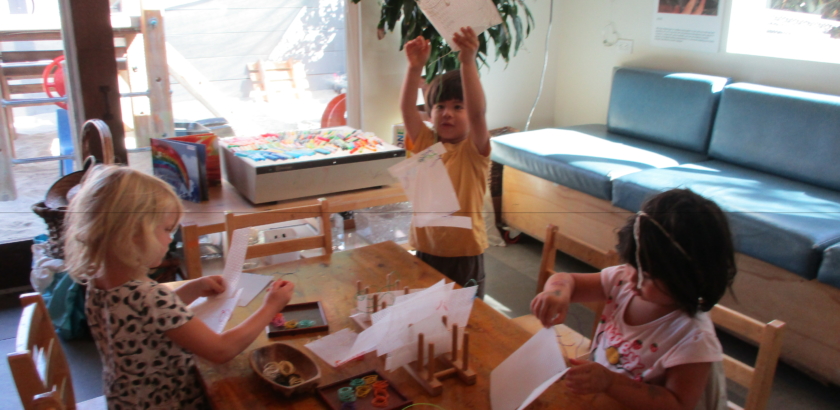
We recognize the children’s growth in the EW and see representational work emerging. When this happens, I often wonder how we support the intention of community contributions as well as recognizing the individual work the children create.
In the Atelier, plastic mesh and wire are set up as a medium to introduce wire as a 3 dimensional representational tool.
Kayden picks up a piece that several children worked on collaboratively. He rotates it in the air saying, “I can make this into a helicopter.”
He adds pieces using wire and plastic mesh. Each addition begins to cover the original idea and the form of the helicopter is no longer evident. Noticing this, I invited Kayden to draw what he knows of a helicopter.
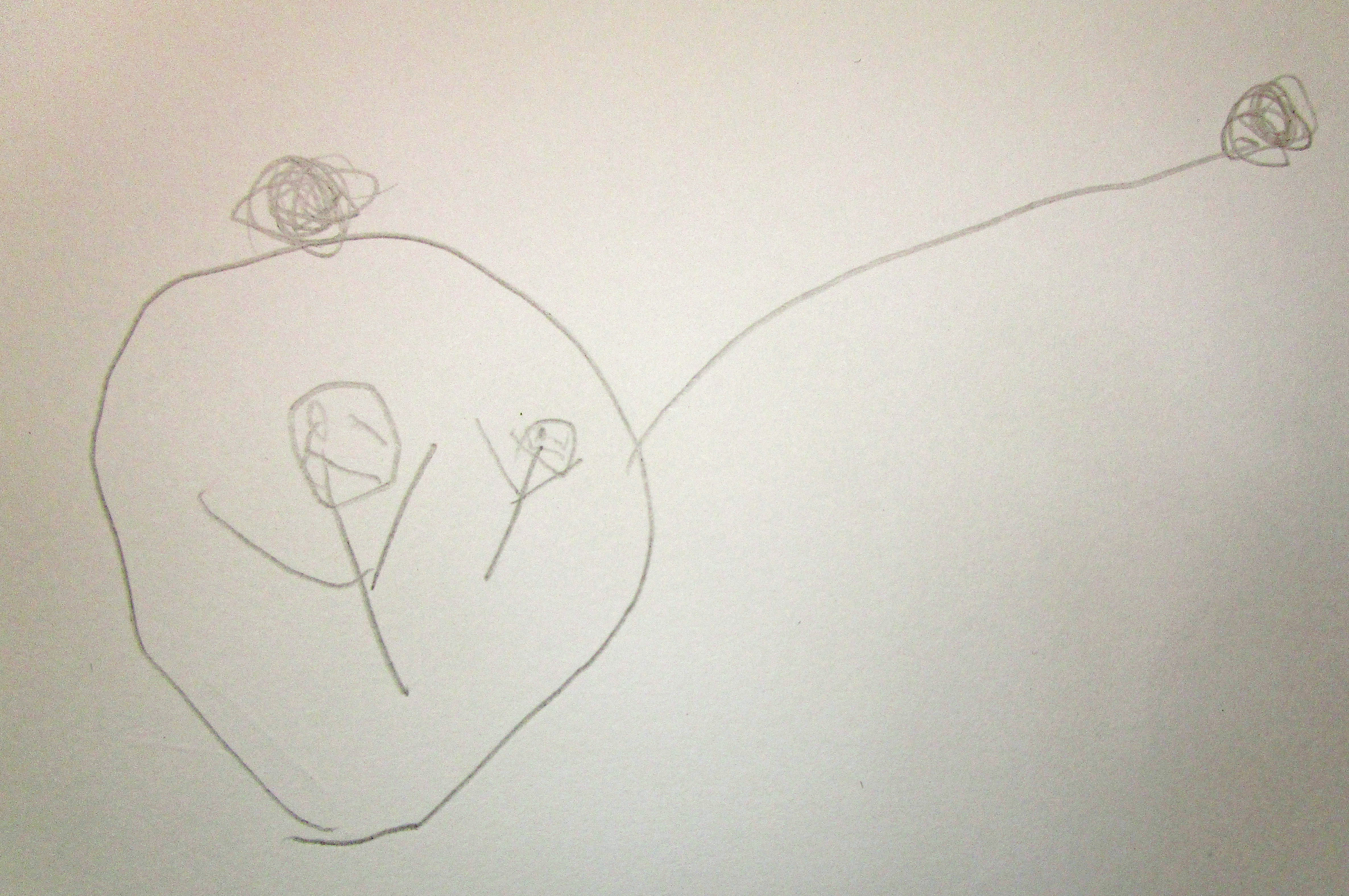
Reflecting on his drawing, he begins to edit out pieces and the form of a helicopter emerges.
“The propellers needs to spin”. Using brads, he adds the final touch.
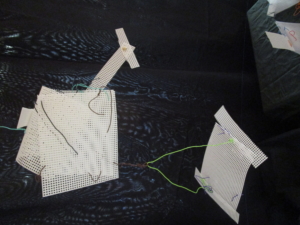
Mabel and Clem watch as Kayden begins to fly the helicopter around the table. “It’s an emergency helicopter. It’s going to save a person.”
To incorporate the group I say, “Where is the person?”
Clem looks up from the house that she is making, “I can make a person.” She begins to snip away at the mesh, connecting parts with brads. A person begins to appear. She draws her formula so other children can make a person too.
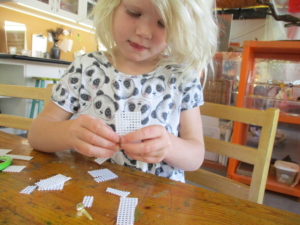
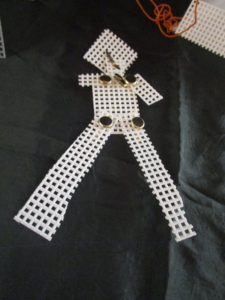
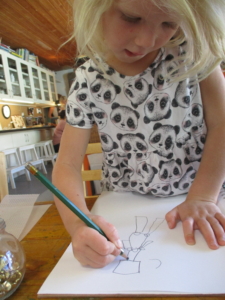
Where Kayden used drawing to develop his idea, Clem used it to create a template for her peers to use.
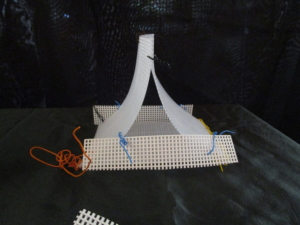
She offers the house as the hospital to where the person will be lifted. The house that Isaac created the day before is used for the patient to go home to feel better and get rest.
During reflection meeting, the story was shared using these props. When the story was over, the children wanted to see it acted out again and then a third time. Recognizing the joy in the children, I wondered how the group might react to making this into a short movie so their peers could watch it and be inspired to make a new story.
After proposing the movie idea, the children became very excited. We met to begin filming. Things didn’t go as smoothly as I anticipated. During our first filming, a person who was not in the scene said, “I want water”.
2nd filming, “Do I go next?”
Another filming, “No, it doesn’t go like that.”
We took a break and played back what we recorded. After seeing themselves interrupting, they made some agreements.
Clem: “You can’t do that in a movie. You can’t just say whatever you want while you’re in a movie.”
Some key points we learned were: Slow down, create a ‘Silent on the Set’ policy, film in small segments, watch your peers, and finally, wait until the camera is off before talking.
By sticking with our guidelines, we created not just one but a few versions of the story before the morning was over.
hospital edited from NSW Documentation on Vimeo.
As I reflect on this experience, my initial goal was for the children to see the value of having an original idea represented in a different medium and how that idea can be flexible and can grow and change when it connects to another idea, becoming something new. When the helicopter was created, it could have become Kayden’s helicopter but as soon as Clem added the person, the helicopter became a part of a story that grew and included other’s ideas of a house created by Isaac, a bed by Gia, and Mabel added a phone to call for help. In the end, this is a story for all of us to enjoy and for us to see a real life representation of how ‘me’ can involve ‘we’ creating the integrated identity of ‘Mwe’ of which Dan Siegel speaks. -Cindy, and Kris