Such an important topic and sounds like it was very informative and super helpful! Find photos and notes below . . .
Naomi orchestrated. Thanks 🙂
Roleen has a notepad. It’s serious.
- podcast: https://anchor.fm/parentingportal/episodes/Tricky-People-with-Pattie-Fitzgerald-e8rplh
- listen to the podcast as a recap
Used to be a preschool teacher
Started in the early 2000s.
Early in the game talked to child predators, LEO, prosecutors, survivors. Ultimately, what stops the predators? possibility of getting caught
- still talks to her daughter (uh-oh feeling, instinct, boss of the body)
Will give us scripted lines & concrete examples
Know how the potential predator plays the game
Will talk through 3 steps
- Learn the facts
- Talk to your children
- Minimize risks
3 Main Things
step 1: learn the facts
- 90% of abuse by someone they know
- 35% within the family
- #1 thing that stops predators – possibility of getting caught
- Snatch and grab is a very very very low percentage scenario
- Statistically largely male predators (95% male). When there are female predators, it’s something about pre-teen child related (or teen child related); replicating emotional attachment where they have the power.
Stranger-danger often does not work. Predators aren’t stupid, and kids just don’t have the discipline to resist a nice guy/lady “hey, come. I have a puppy”
Put out an involved & engaged parent vibe
Parents should also pay close attention to older children who are playing with the younger ones. They may be @ different stage developmentally and experimenting with different things.
Two elements are needed for trouble: access & alone time/privacy. Pay attention to who is paying attention to your kid.
Step 2: talk to your kids
… about what’s ok, and what’s not ok
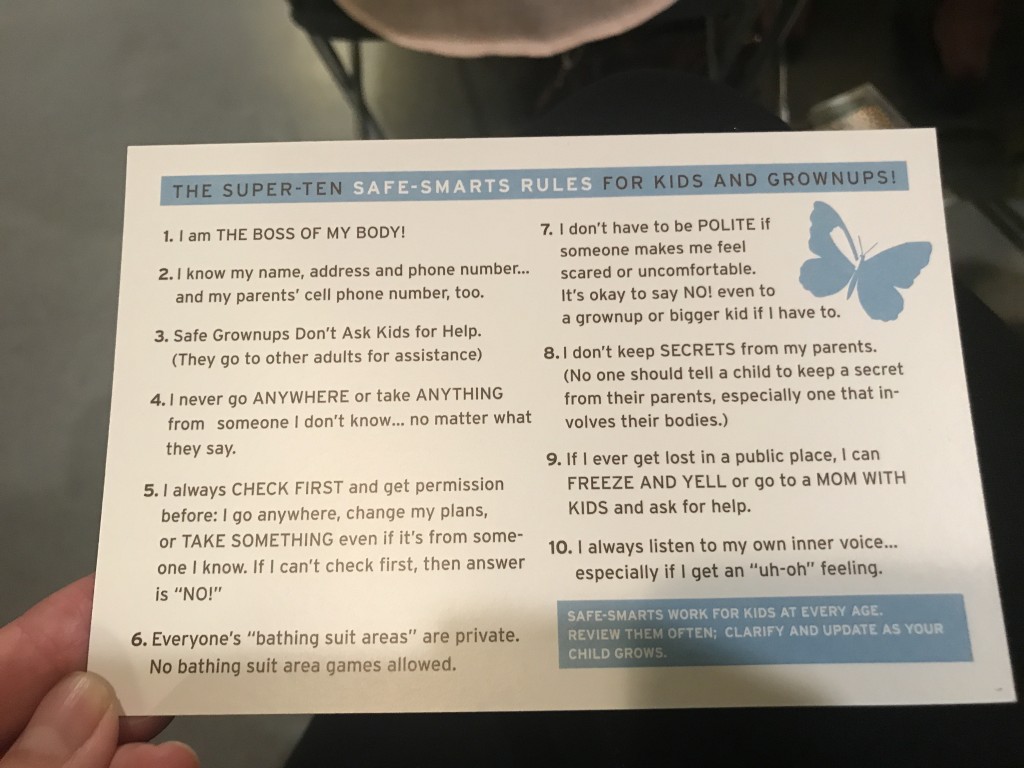
You say: “you are the boss of your body”. Great time to talk? Organic. Like, in a bathtub
“I went to miss Pattie the safety teacher’s class and she said now that you are a big kid, you are the boss of your body. You can make the rules about who can touch your body”
Your kids will turn this against you: “not taking bath cuz I am the boss”
You say: “Parents are bosses of health and safety and staying clean is for your health.”
You say: you are the boss of your penis / vigina
Use proper names. Predators don’t use those words. Worst case if the child has been touched but does not know how to talk about it. You want to give them the vocabulary to make sure you understand what they are telling you.
You have a penis / vagina and you will need it for the rest of your life and you need to protect it. When you notice that kids are touching, you can say something about how when we play we don’t touch my vagina penis game . Nobody should play touching game with your private parts and nobody should play the game with their private parts.
- You can sort “role play” do the “what if” situations with them about that
Recapping 2.1 – 2.3 and adding two more, we teach them these things:
2.1 Stop. Don’t touch my private parts (outstretched arm)
2.2 Walk away
2.3 Tell your grownup
2.4 No Secrets
2.5 Check First rule
2.4 No secrets.
Some kids have secrets. Teach them:
no secrets about your body, or no secrets about your private parts
Predators will say “it’s a secret”
- Ya ya touches
- No no touches
- No secrets
Don’t assume that if you are close they will tell you about things. They don’t know to tell you. Or how to tell you.
For older kids, you teach them to check first (“sure, but got to check with mom/dad etc. first”)
“Ask first rule” – teach on way to something public like park, store, beach, etc
- Play “what if” games about that
- Exaggerate the fact that you are trying to trick them to make it a little bit obvious that it’s a game and you are trying to trick them
- If they start to roll their eyes at you and say they KNOW already say, “I know you know but I am your parent so I have to”
Tricky people trying to trick people into doing things
Yucky feeling about that. Or yucky uh-oh feeling about that..
They will say “you don’t have to ask about that”.Your job is to teach the kid to say “I am the boss of asking. Of course I do.”
A way to probe:
Tell me 3 things you did in school / today and I”ll tell you three things I did @ work today
Sidebar
Check on your kids. Other people (predators) notice parenting styles. Show up; sometimes unannounced.
We don’t necessarily teach younger kids ‘tricky person’ yet. (You tell them about “bad people” at about 9 or 10 years old, or so)
Ya ya safety rules
When confronting a situation state your facts without blame or judgement
Example: some person approaches on the street and keeps insisting on saying hi or engaging in some other way. You don’t feel great. Trust your instinct.
- One thing you can say “I guess we are not saying ‘hi’ today. We are working on our safety rules.
- Another thing is to engage the broken record (if they keep insisting, you keep saying “yeah. Sorry. I guess we are not saying ‘hi’ today…”
Snatch and grab is very uncommon
- When going to the park – bright clothing
- Statistically, safest person to seek help from – mom with kids
- Tell your kids if they get lost in a store, the Cash register person will use the loud speaker to call you to come get them.
Step 3: Minimize risks
Job is to minimize opportunities that uncle creepy gets alone time with your kid.
Notion of observable environment
- You’re making judgement calls about observable environment
- Keep the doors open
Remember: access & privacy are needed for bad things to happen
- Who has access to your child?
- How excited they are about what
What are they asking and what’s the context? This type of thing falls into broad discussion of “tricky people”. Pattie spent a bunch of time talking about people that you should really watch out for. The other keyword here is grooming.
- Some teacher bringing unreasonable presents, and in exchange suggesting to take student on “alone” trips or sleepovers etc (sound unreasonable)
- Safe adults who know your kids aren’t looking for more alone time with your kids
Grooming is essentially building an emotional connection, which can then be exploited. For example, excessive and unreasonable help in tricky family situations, etc. Is it excessive?
Who is presenting what idea to you?
Mostly males are predators, but Pattie watches out for Koo-koo-ville behaviors:
- Too many in and out boy/girlfriends
- All kinds of erratic behaviors
- Leaving the kid with an unreliable friend when going to get food or some other errand
- Are there adults you don’t know in the babysitting environment? Boyfriends etc?
Above we talked about you doing things to show potential predators you are one step ahead of them:
- “Marissa says” technique – “she talks about school all the time. I can’t wait to hear what she is going to tell me”. Apply this to other contexts. You are sending a message of no secrecy
- “You know, you will think I am crazy, but I am just not comfortable with that one. I am sure you’ll understand”. Safe people will shrug; unsafe people will act weird. In that case you just do the broken record.
Sleepovers
1. Pattie isn’t comfortable with sleepovers and offers two options:
Option A: No sleepovers, but can do a sleepunder. (all the things that go with a sleepover like dinner, games, pajamas. . .but the children go home to sleep. Or Option B—a very short approved list (maybe 2 or 3 other families at most) where your child is allowed an occasional sleepover. For example: if you decide to allow your child to sleep at someone’s home, be very specific and create a very SHORT APPROVED list of where your child can do this. It may be one or two families that you’ve known since preschool or kindergarten, where you’ve already spent a considerable amount of time and feel confident that the parents have the same “parenting style and safety boundaries” as you do. I allowed sleepovers for my daughter but only at 3 specific homes where I knew the family very, very well and also knew they would not be leaving childcare to babysitters or older siblings
2.Warning signs for when it’s very much a ‘no’
- Substance abuse
- Older kids (+4 years over yours)
- Who’s watching the kids
- Have I taught Marissa how to protect her body?
- Does she know that she can call any time and I’ll go pick her up and won’t be mad (tell the parents it’s ok, so that they are welcoming if Marissa wants to use the cellphone)
3. Remind what’s ok and not ok @ the sleepover. Every time.
Tool:
I am not comfortable w/ sleepovers so I started saying ‘no’ to them
Internet
- Limit the time
- Not in the bedroom (visible space)
- Filter & blockers are great tools
- YouTube – no (use ‘YouTube Kids’)
- Share passwords with parents
- No social media (until they are older. COPA is 13)
- All phones & gizmos start around middle school. Ugh.
Nudity around siblings
- Normal to be curious about body parts
- Teachable moments (we don’t share private parts)
- Siblings – not the end of the world if they see each other naked, but do teach modesty. Should not be taking baths together after about 7 yo
- No sharing baths with neighbors’ kids
Usually by 7 modesty starts to kick in
Just don’t want the kid to think it’s ok “out there”
Tickling
- Opportunity to teach consent
- Teach thumbs down touches
Relatives
- Don’t force your kid to touch & kiss
Tool:
We’ve been practicing being the boss of her body, so when she is out she practices the same. Please help us with that.
Yes, you still need to say goodbye out of politeness.