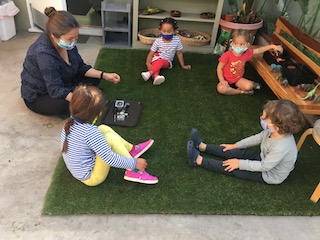
Working in the Middle Courtyard offers the Cilantro group the gift of sitting in the center of the whole community of NSW. Through our transparent dividers, the group was welcomed by the Aloe and Basil East Wingers and introduced to the other WW pod, the Dandelions. During our first days, the children became very curious about the experiences the other groups were having. On this particular morning, they witnessed a group of East Wing children working in the front yard:
Leo: What are they doing?
Cindy: Are you noticing the children use the hammer and nails? They are woodworking.
Leo: I want to do that too.
Knowing the value of woodworking with young children, we had anticipated interest and stocked materials on the shelves in the Middle Courtyard for the Cilantros. When looking at our selection, Leo was curious about screwdrivers. Taking his lead, we set up a small area to test this new tool. Quickly, other children in the group became interested. Along with the screwdriver, the tape measure became an intriguing tool. Copper measured many wood scraps and Jack compared the Phillips and Flathead screwdrivers with the screws.
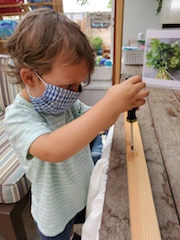
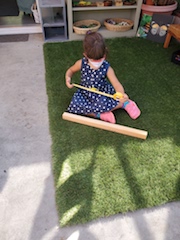
Cindy: There are so many possibilities. What ideas do you have for working with wood?
Leo: A house for the dinosaurs.
Cindy: Many of the Cilantros are interested in dinosaurs. We can share the idea with the group.
Ami: I’m going to build a dinosaur house too. She began constructing with the scrap wood that Copper had been measuring.
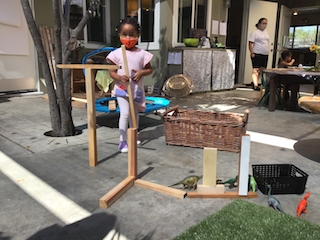
The next morning, Silvana began the day by playing the song “When I Build my House” by The Parachute Express. The group loved playing out the actions of the tools in the song.
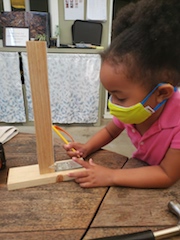
After the morning meeting, a group met in the Middle Courtyard and took turns trying the hammer and nails, screws with screwdrivers, saws, and even our power drill. Though the intention was to familiarize the children with the functionality of the individual tools, it was also an avenue for them to have a dialogue and share their ideas.
Leo: I want to build a dinosaur house.
Ami: Yes we can.
Oona: We can build one. (She hammers a nail into the wood and flips the wood over making it stand on an incline). Or we can make ramps.
Cindy: Look what Oona made. She’s calling it a ramp.
Leo: We need cars.
Luka: We have a car.
Leo: But let’s work on the dinosaur house (recognizing that they were each working on separate pieces of wood). We need to hammer the wood together.
The group agrees to test the ramp later and to also create a dinosaur house.
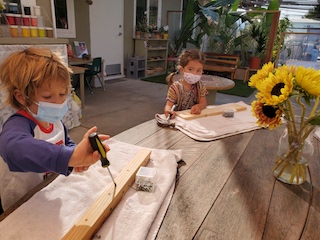
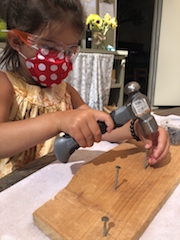
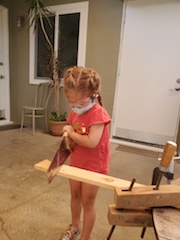
Another group was introduced to woodworking tools.
Cindy: I heard the previous group discuss a plan for a dinosaur house.
Dot: I can cut the wood.
Emme: I will too. I want to build a house for the dinosaurs.
Dot cutting a piece of wood for the Dino house
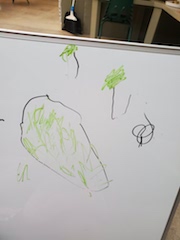
Each child had a chance to test our tools and had become intrigued about the construction of a home for dinosaurs. We planned a meeting to revisit the idea and to listen in a smaller group. I wondered, with this group’s strong common interest in dinos, what do they consider when thinking about a home for dinosaurs? We brought out a large dry erase board to support the group in drawing out their ideas.
Cindy: I heard you are all interested in making a home for dinosaurs. What would we need?
Luka: Toys!
Copper: Food
Luka: Vegetables.
Emme: Well, some like meat because they are carnivorous.
Emme: They live in the Great Valley.
Ooma: Yes with trees.
Emme: and grass.
Oona: and lots of trees. Tall ones too.
Cindy: Emme, could you show us what that would look like?
Emme drew a large circle on the board: This is the Great Valley.
Oona: Can I draw the trees? She approached the board and drew a long brown trunk.
Copper: I can add the green.
Cindy: So if we are building a home for dinos, what should we do?
Oona: We need to build trees and have a lot of grass.
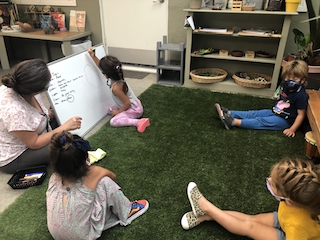
The group transitioned over to the large table and worked as partners to draw out a design to share with the whole Cilantro group.
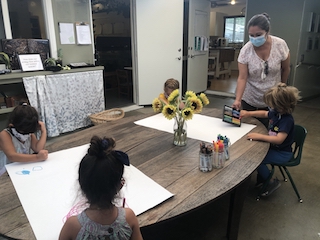
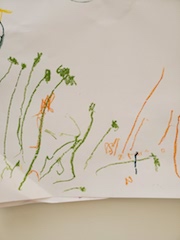
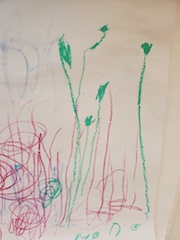
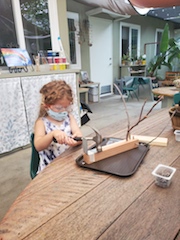
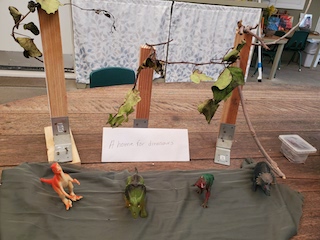
Children make connections with others in developmental stages and in the early years they relate to each other by way of their own experiences. What’s comforting to them must be comforting to others! As this group talked through their plan, they began to come to the conclusion that a dinosaur, in fact, does not need a house with four walls and a roof but actually a giant land with green grass and many trees. This is an example of the group moving further along in their developmental stage of empathy and we are moving along with them. With this new blueprint of ideas from which to refer, we are creating prototypes of trees to test in the Great Valley.
https://hundred.org/en/articles/the-importance-of-woodwork-in-early-childhood-education