The children brainstormed different ways to exchange messages between the Aloe Vera and Basil groups. Once formulated, we not only challenged the children to test their ideas, but also noticed their initiative to put those ideas into practice and to spontaneously develop creative ways to communicate.
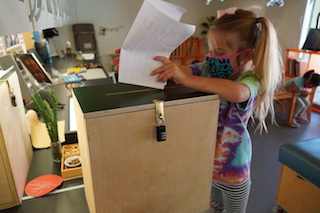
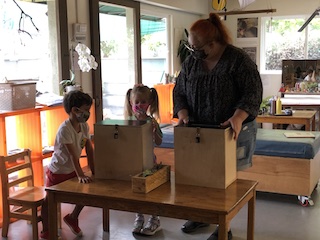
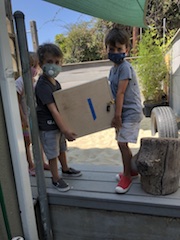
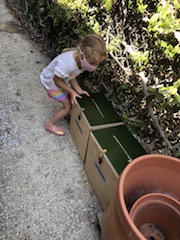
In the Aloe Vera group, Presley shared with her family her enthusiasm about using a mailbox system for correspondence. Together, they designed and built two mailboxes, one for the Aloe Vera group and one for the Basil group.
At the same time, the teachers invited the children in the Basil group to try out their ideas.
Susan: Jack, do you remember the idea of writing a note and laying it on top of the cubby for the Aloe Vera group? Do you want to test that idea?
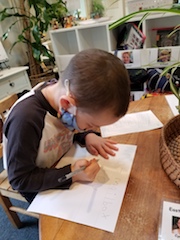
Jack: Yeah, I want to write a note to Amy. I want it to say, ‘How is the group doing?’
Susan: How do you think we could let them know that there is a note for them?
Jack: Maybe we can hold it up a little bit so they can see. Oh, maybe we can tape it to the wall so they don’t have to bend over every time to look at it.
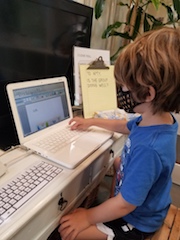
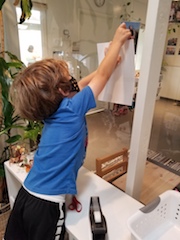
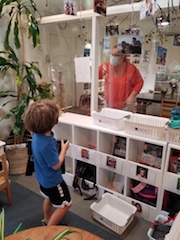
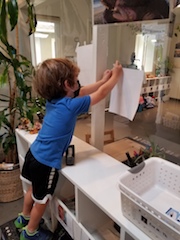
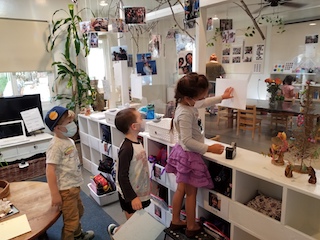
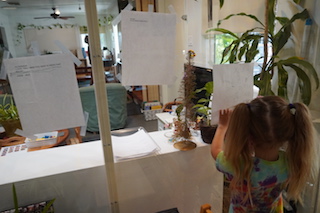
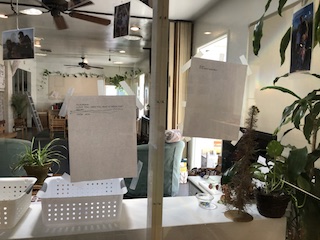
With some support, Jack typed the message to Amy and hung it on the plexiglass wall using tape. Serendipitously, Amy walked into the classroom at that moment. After reading the note, she responded to the message with a thumbs up. The experience of this exchange spurred a desire to create another note. This one read, “What is in that room?” alongside an arrow pointing to a corner in the Aloe Vera classroom that was hidden by a curtain. After taping it on the plexi, we awaited their response.
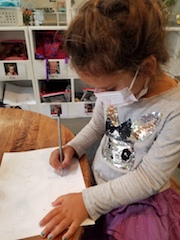
Adriana and Amy shared the messages that Jack put on the wall with the Aloe Vera children. Together, they brainstormed their answer to Jack’s questions. Presley volunteered to write the response since she was so excited about the new mailboxes. She left her note in the mailbox for the Basils.
Amy: How will Jack know his answers are in the mailbox?
Presley: I know! I can write him a note to tell him his answers are in the mailbox.
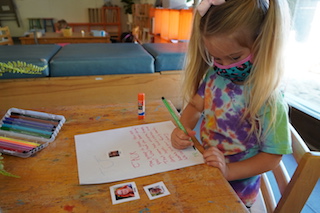
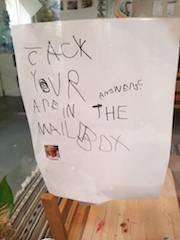
She wrote him a message and taped it up to the wall.
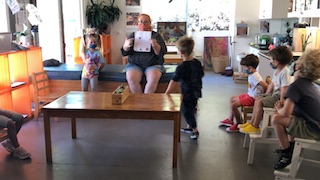
During meeting time, the Basils noticed Presley’s response.
Tallulah: I see some notes that I think are from the Aloes to us. It has words on it and it’s from Presley!
Penny: What’s on it?
Cynthia: It says, “Jack, your answers are in the mailbox.”
Tallulah: What mailbox?
Everly: Our mailbox we have!
Tallulah: Maybe they went out that door and put it in that mailbox.
Cynthia: You think they’re talking about the mailbox in the front yard?
Asher: Yeah, the mailbox outside!
Everly: Let’s see where the mail is and then we can find out what the mail says.
Mars: What mailbox is it? (Seeing Tallulah pointing to the mail box in the Front Yard)
Cynthia: Do you want to check that mailbox first to see if that’s the one?
Asher: Yeah!
Susan: And where would we put that message?
Rufus: On the window with the tape.
The children excitedly checked the mailbox in the Front Yard and discovered that it was empty. We asked the children to think about what they could ask to get more information from the Aloe Vera group.
Tallulah: Maybe we can say, ‘What mailbox were you saying about?’
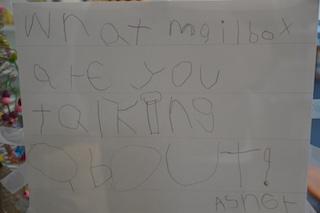
Mars: How about, ‘What mailbox are you talking about?’. That was the same idea I had!
Keaton: We can look at the mailbox and then ask them and then check again.
Susan: Do you want to tell them that we checked that mailbox?
Keaton: Yeah, and we can say it’s not there.
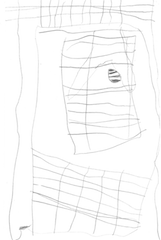
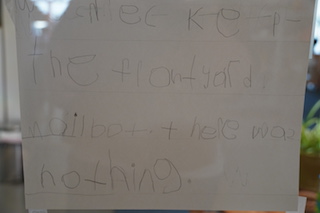
Asher and Tallulah decided to write down the Basil’s response to the Aloe Vera group, which read, “We checked the front yard mailbox. There was nothing. What mailbox are you talking about?” In addition to the written message, Asher drew the front yard mailbox – “Here’s the mailbox and the door. That’s the mailbox we checked!” While taping the notes on the wall, Asher, Mars and Tallulah saw Amy read the notes. During reflection meeting, they shared what happened with the larger group.
Asher: Amy came and told us, ‘We’re going to give them another note.’ I was feeling excited!
Rufus: When we come back from school, the note is going to be here. The other note will be here because last time, before we came, the note wasn’t there and then when we came again and it was there.
Susan: We’ll have to see! Maybe there will be a note waiting for us when we come back to school tomorrow.
The next day…
Amy: Yesterday, Presley left a message for Jack that said, “We left the message in the mailbox.” Then we saw a new message on the wall that says, “We checked the mailbox and it’s not there.” They checked the Front Yard mailbox.
Poppy: That’s not the mailbox we are talking about.
Presley: We are talking about the mailbox my family worked on. We need to tell them it’s the Basil mailbox that lives in the community garden.
Poppy: Write down, ‘It’s from the Aloe Veras’.
When the Aloes added their response, Cynthia read it to the group – “Basils, we were talking about the mailbox that was made for the group by Presley’s family. They made one for Basils and one for Aloe Veras. We will leave it for you in the community garden!”
Keaton: We have to go!
Asher: I’m sooo excited!
Everly: How do we know which one is ours?
Keaton: Maybe we can write them a note that says, ‘Which one is our mailbox?’
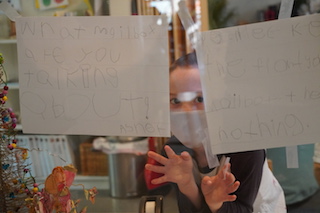
At the same time, the teachers recorded an interaction between Keaton and Levi on opposite sides of the plexiglass wall. We decided to share the video with the group and invited them to think about what was happening.
Susan: What do you think is happening?
Mars: They were playing, but that’s not happening to the real Keaton because he is wearing a different shirt.
Keaton: Actually, I have that shirt you know.
Asher: They were playing a game right over there (points to the plexiglass wall).
Keaton: That’s the window. We talked to each other before the video. We just said, “Dance, dance, dance.”
Cynthia: You were dancing!
Keaton: No, we were playing a game! A copy game. A copycat game.
Everly: It reminds me of hide and seek because someone can’t see the other person when one person was going down.
Tallulah: They would hide behind the cubby, and they would bounce back up.
Aloe Group
Adriana: What did we notice in the video?
Levi: Me and Keaton were just playing a game and going up and down and hiding from each other. We weren’t talking. He wanted to play with me. Up and down means hiding.
Presley: Maybe they will just play without talking.
Levi: We were on different sides. We got to see a feeling (through the wall). The middle wall connected us. It did!
Poppy: It connected people without touching.
As we reflect on the multiple interactions between the Aloe Vera and Basil group, we are able to step back and make sense of our role as teachers. It is essential for us to support the children as they construct and organize their own systems for reciprocal communication. Writing messages to speak through a clear wall, playing a hide and seek game and exchanging mail are some of the ways we see the children expressing themselves. As we move forward, our hope is to continue creating the conditions where children feel motivated to test different ways of connecting with one another and to feel that we value these expressions as a form of communication. We wonder what others forms of communication the children will express?
As we reflect on the multiple interactions between the Aloe Vera and Basil group, we are able to step back and make sense of our role as teachers. It is essential for us to support the children as they construct and organize their own systems for reciprocal communication. Writing messages to speak through a clear wall, playing a hide and seek game and exchanging mail. Sometimes the intent of a message is misinterpreted because the context for each group is different. We also see the children beginning to notice the subtleties of each medium. Posting a message on the wall affords speed and the possibility of seeing the reaction of the recipient. Sending a message through the NSW mailbox offers a tangible experience. Playing a hide and seek game creates a space for attunement.
What is evident in these exchanges is the emotions that come into play. Each message is wrapped with an abundance of feelings that is carried over to the recipient and then carried back. Whether that message is in the form of written correspondence or a spontaneous game, the children, as Levi aptly states, “…see a feeling. It connected us. It did!”