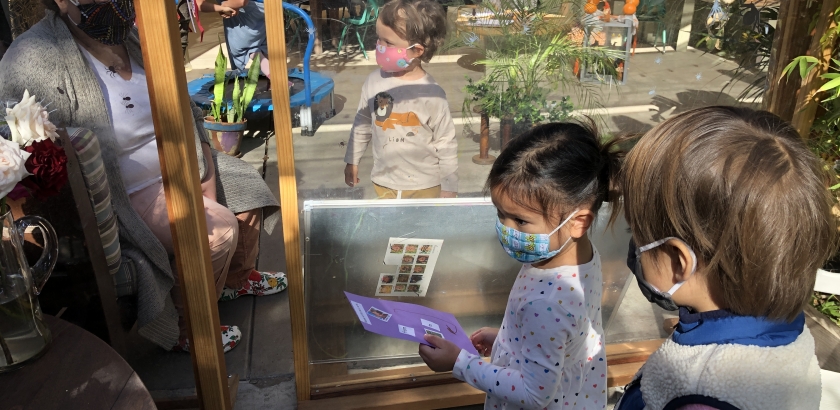
The children in the West Wing became increasingly interested in giving and receiving notes to one another. We planned to come up with a better system for note delivery between the Cilantros and the Dandelions. The previous system, where a teacher on each side was needed to facilitate and coordinate delivery, was not supporting the children’s autonomy and independence.


The Dandelion teachers invited the children to brainstorm with us at one of our Reflection Meetings.
Flora: If you want to write a note like Leo wrote to Eddie, how can we exchange notes with the Cilantros?
Eddie: He could put it in my hand.
Flora: You know, right now it’s a little tricky to hand notes directly to the Cilantros’ hands. We want to make sure that our bodies stay healthy by keeping some physical distance.
Dana: Flora and I are wondering where else a Cilantro could put a note for us, or we could put a note for a Cilantro?
Emma: A mailbox.
Flora: Oh, a mailbox?
Cary: A box where you put mail in.
Marcel: One outside.
Flora: Maybe we can make one.
Leon: Uh huh!

With this idea in mind, a small group gathered together to think more specifically about the details of the mailbox: its size, its shape, its location. We brought out a couple of different materials that the children could use to express their ideas, including a white board and markers.
Eddie: It’s for paper for people.
Evyn: A pretty mailbox with pink paint.
Emma, using her hands to show the shape: It’s shaped like a “U.”
Dana: Like a “U”? Emma, can you use one of the dry erase markers to show us what you are thinking about?
Emma, drawing on the white board: See, it’s like this. A “U.”

Dana: Where do we put the notes inside?
Emma, pointing to the open side of the “U”: Here.
Marcel: There’s a door. You need to open the box to see if the note is inside.
Emma, continuing the line so that the “U” shape closes: Yeah, a door.
Cary: That looks like a pillow.
Eddie: That looks like a rectangle.
Dana: There is one door? How does it work?
Marcel: You open up the door and you put in the note for the Cilantro.
Dana: How does the Cilantro get the note out?
Cary: There’s another door on the other side.
Dana: So there are two doors?
Ana: Yes. Two doors.
Dana: How do the doors open?
Eddie, putting his hands together and opening and shutting them like with a hinge: Like this.
Dana: Hmm. I’m wondering if we can use another material to show how the doors work. Let’s see if some blocks might help.
We brought over some of the blocks from the building space to see how the children would represent their idea for the box with two doors. The children worked together to build a long rectangular shape where the long sides swing open.

We took our whiteboard drawings and our block prototype back to the Reflection Meeting.
Dana: We are thinking of a system where we can deliver notes [to the Cilantros] where a teacher is not outside or the person you want to deliver a note to is not outside. Marcel, can you come show us what we were working on?
Marcel: This is the front door, and this is the back door. See how I am opening this? There’s two doors. This is me when I grab [a note] out [on one side], and this is me sending it [on the other side]. Then I close it up!

Dana: It’s like a hinge motion when he opens it up.
Marcel: There’s a roof.
Evyn: So no one can pick [the note] out. Only the person at the door.
Eddie: The blocks are falling!
Dana: I am wondering what material might work better than blocks?
Emma: Maybe plastic.
Marcel: Metal. Maybe wood.
Eddie: Wood.
We continue to think more about the mailbox and its construction while partnering with the Cilantros. We will follow the children’s ideas and test out their designs. Titziana Filippini, a pedagogista and collaborator with Reggio Children, explained to the Westside Collaborative in a Zoom call that “Every question, every response, hypothesis, and affirmation a child makes is an important idea. Even if it may seem wrong to you, welcome it with words of approval. Then, without saying it is wrong, you can cast doubt on it by asking questions, or by reformulating what a child has said to gain a better understanding of what they meant, or by suggesting they try again and comparing the results. You will see that together with children you can have fun too, and you’ll discover things you had never even imagined.” We are already having so much fun and discovering so many things!