The Cilantro group began the year by becoming familiar with mark making tools. As their confidence developed, we noticed circles organically appearing in their drawings. On large papers, partners used circles as a playful way to connect their colorful marks. As they doodled on clipboards and dry erase boards, we recognized that this group had begun to expand the circle and found the power it held as a template. For some, the circle became a pumpkin, for others a sun, a flower, or a face. Clay and wire have been introduced as new mediums to offer 3- dimensional opportunities of expression.


We now see ourselves as a circle of friends within the New School – West. How can we work together to find the circles in our ordinary day at school?
We proposed that we go on a Circle Hunt and to added digital photography by using an iPad.
Cindy: If we are looking for circles, how would we know if we found one?
Dot: It goes around and around.
Copper: It’s a circle.
Cindy: How do you describe a circle?
Copper: It’s round.
Luka, drawing a circle in the air: Around and around.
Leo: Like my eyes.
Dot: Cindy, your face is a circle too.
Hearing the group reference people as having many circular parts, I wondered how their ideas would play out while they manipulated circles in Sculpey clay.
Aminata, rolling out long pieces of clay: I’m going to make myself.
We support the children when using new materials to apply the same familiar steps when using mark making tools: Slow down and break the big idea into smaller parts.
Cindy: Where will you begin?
Aminata: I want to start with my legs.

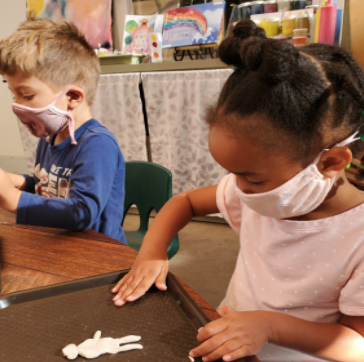
Her first attempt fell apart when she tried to lift it off the tray. We slowed down the process to notice the thickness and scale of the body created. She remained persistent as she reshaped the clay. Her peers at the table observed and agreed a person has a body/torso, a head, legs, and arms. This supported her as she created each part and attached them together. Feeling so proud, she spent extra time adding facial features.
The following day, the sculpted person was brought out as an inspiration for her peers.
Jack: I want to make me too.
We shared how Aminata created the separate parts and then attached them. She also shared how she used a toothpick to add facial features. Jack got to work and suddenly felt discouraged.
I can’t make one. Maybe if I draw one, then I can make one?


We brought paper and pencil over and Jack referenced the six key parts that were needed to create a person. He started by drawing an oval shape for the torso, added two legs, two arms, and then created a circle for a head. Next, he shaped the clay into sections and then, when attaching the body parts together, he opted out of adding the circle head as he felt that the torso already had the appearance of one. Then he stayed still for a moment and stared at his work, “I’m ready to add my face, some eyes, a nose and a mouth.”
Colette watched with intrigue from across the table. She also wanted to try. Again slowing down each step, with encouraging words, she too created a person.


When sharing this work with the rest of the Cilantro group, many of the children showed an interest in creating themselves in clay. We brought the baked pieces out for another look and Ami made an observation about the color of the clay.
Cindy: Ami, you said that you were making yourself. What do you notice? What could we add?
Ami laughing: But I am not that color. I need to add brown paint.
Colette: I am beige.
Jack: My mom says I am multi.
Cindy: You are multi?
Jack: Yes, look. He turns his arms around and he lifts his palms up. See!
Ami: Me too, I am cinnamon and my hands are peach.
Cindy: So you are all thinking paint would help your clay pieces look more like you?
The group agreed and we are now on a new journey with paints.
Though this is their first time representing themselves in Sculpey Clay, I recognize it as the beginning of many iterations of their self portraits. With that thought, I also felt it was important to connect this new experience to their previous experiences. During our time exploring colored water, the group named their collection of colors ‘A Family of Colors’. At that time, they recognized that all of us are made of different colors, even within our own families. Now we are circling back to color. This group loves blending primary colors to create new colors. With this, we wondered how these same paints could be used to create the colors of us. What would we name our color?
