A small group of Dandelions worked together to build a “tall, tall tower” in the Exploration Space with the aid of a step stool. The blocks were stacking higher and higher until… they fell.


Leon: That didn’t work.
Marcel: Let’s repair it.
Eddie: Here’s a piece.
Marcel: Whoa, that’s very tall. Like a Tyrannosaurus Rex! Eddie, it’s your turn.
Eddie: My turn!
Marcel: Right here.
Leon: Marcel, can you put this [block] up there?
Marcel: Add on to the tall building, Leon!
Leon: I think [the ladder] is too big.
Dana: Why don’t you ask Marcel to hold onto the block so that you can use two hands to climb?
Marcel: Okay. Here you go!
Leon: I think I cannot do it.
Dana: I remember you climbing that ladder outside, Leon.
Eddie: You can do it, Leon!
Marcel: Yeah, you just have to try!


Sometimes the support that you need to accomplish a big task is more than just a step stool — it is the encouraging words of a friend.
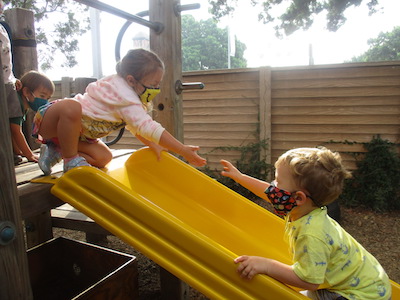
We see how the children give support in many different ways in the Dandelion group. They share those types of encouraging words…

Leon: It’s stuck.
Ana: We can pull.
They offer a helping hand…

They check in with each other when they might be feeling sad or disappointed or frustrated or hurt…

They share in each others’ joy and ideas…


They create notes and drawings for one another, using their peer’s favorite colors…

Olivia: I’m making a note for Cary. Red is his favorite color, and it is my favorite color!
And they ask about each other: how are you? What do you like? What do you want to play?

All of these different methods of support speak to the children’s growing sense of perspective-taking. As Ellen Galinsky and the Mind in the Making program explain, “Perspective Taking goes far beyond empathy: it involves seeing things as others would see them: their likes, dislikes, feelings and thoughts. It involves executive function skills, including remembering how others might respond (working memory); inhibiting our thoughts to understand the perspectives of others (inhibitory control); viewing situations in different ways (cognitive flexibility); and considering the thoughts and feelings of others (reflection).
Perspective Taking emerges in children over time but needs to be encouraged. Children with perspective taking skills are more likely to adjust better to school, to understand what they are learning through reading and writing and to build positive relationships with less conflict.”
We believe now more than ever, it is important to give children the understanding of how they as individuals relate to others — and then how they can support and strengthen their whole community. By belonging to a community, whether it is based around a household or a school or a neighborhood or a city, we become intertwined with it through collective efforts, actions, and responsibilities.