It takes practice to understand that each person has a unique point of view. What one person sees and what feels true to them may differ from someone else, and yet that doesn’t make them wrong. Perspectives can be broadened when minds are open to different ways of seeing.
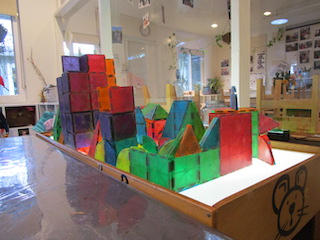
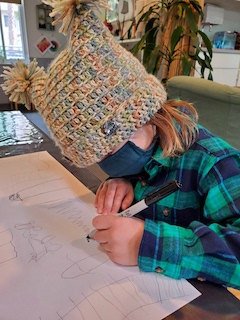
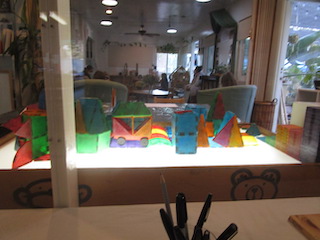
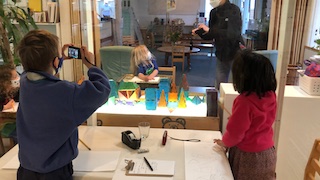
To support this, we decided to set up a provocation where children could learn from each other’s perspectives. Moving the light table in front of the plexiglas wall that divides the Aloe and Basil pods, we invited the children in the Basil group to build a structure using Magnatiles. Afterwards, we welcomed pairs of children in both groups to examine the structure from two different angles and draw and photograph them.
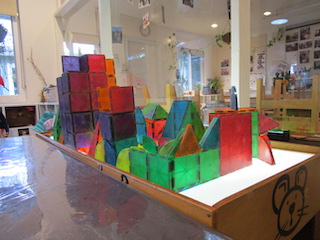
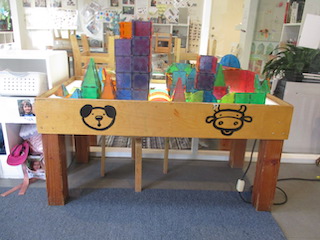
Aloe Vera group illustrating their observations of the Basil group’s provocation.
Adriana: Let’s take a closer look at the structure the Basil set up for us. What do you notice about their structure?
Christoph: I noticed that they used different Magnatiles for their buildings. I drew this one on the back on my paper and I also focused on the tall building they made.
Colin: I noticed there is a pyramid. I am going to draw it and take a picture. I see the dinosaurs next to the pyramid. Mia, do you see the pyramid?
Mia: Umm… I see the tall building. (stands up) I don’t really see the pyramid.
Colin: I see it from here!
Adriana: Isn’t it interesting how some of you get a different perspective?
Mia: (Smiles) Yes! I see the building and Colin sees the pyramid.
Santi: I took a picture of their building. It helped me know about it. Then I drew it and I counted the squares to know how many squares to draw and where I was going to add the triangle. 1, 2, 3, 4, 5 squares and one triangle.
Chloe: Well, I see the cars and the tall building. I drew the cars.n They look kind of upside down.
Adriana: Yes, I noticed your drawing and Santi’s drawing are different.
Chloe: That’s because Santi is close to that building and I am closer to the cars.
Through this collaborative process, they began to recognize what shapes an individuals’ perspective of the structure. It seemed to be the distance, angle, what pops out to the viewer.
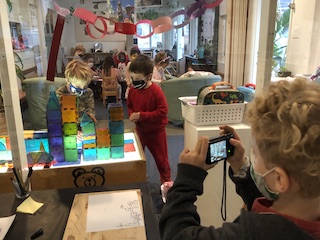
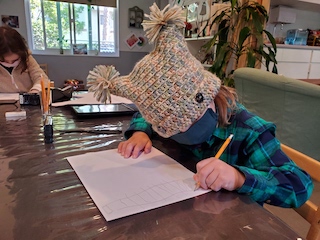
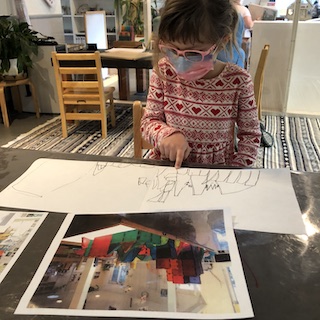
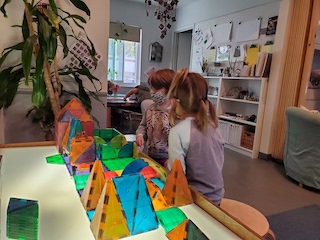
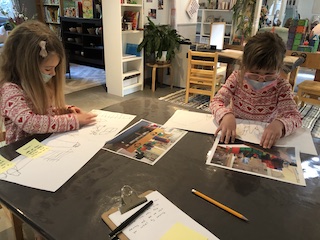
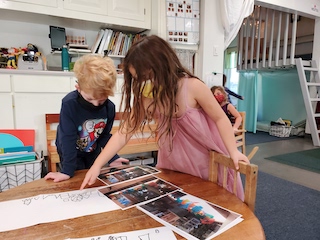
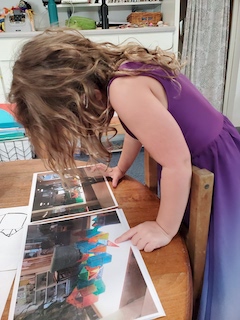
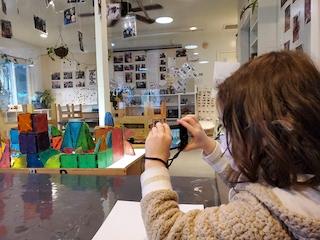
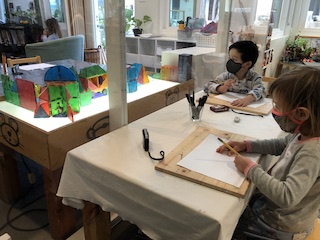
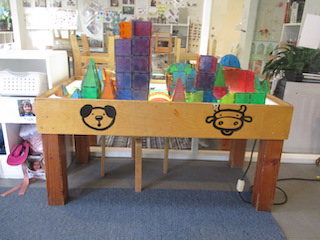
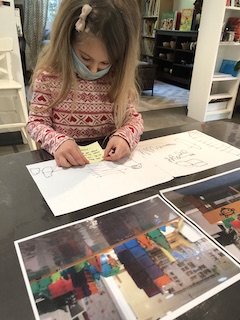
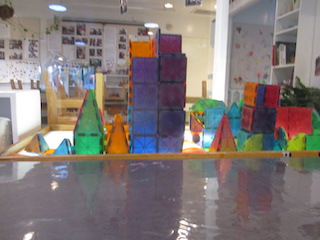
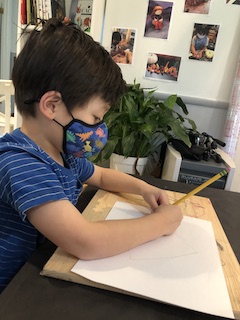
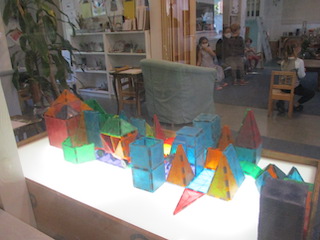
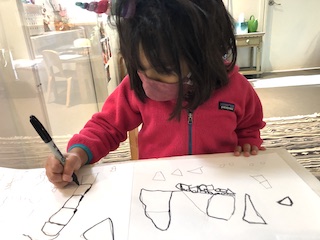
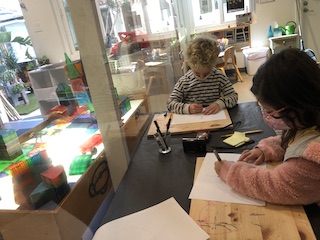
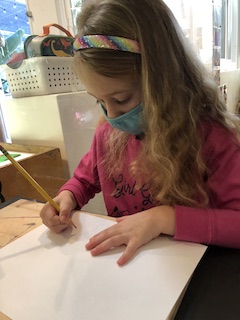
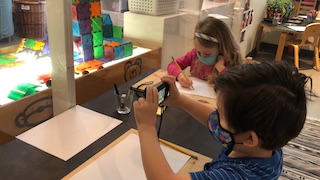
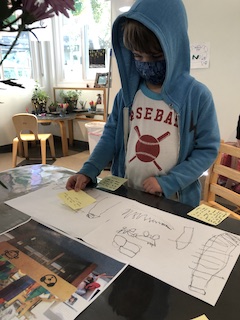
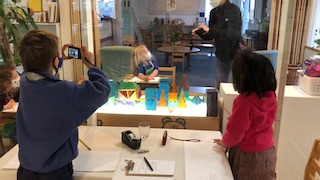
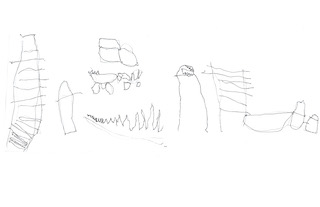
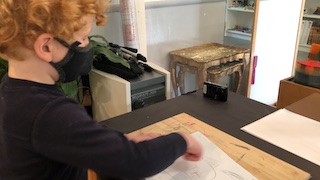
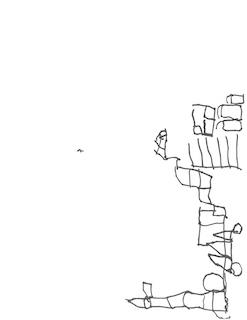
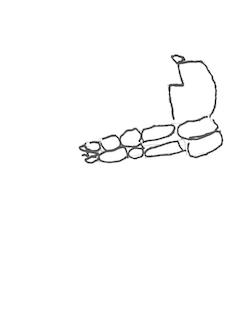
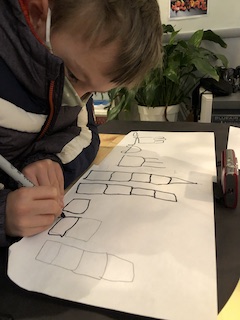
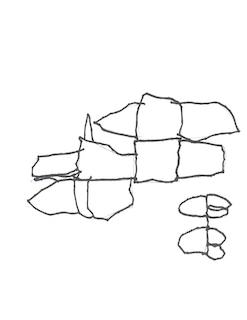
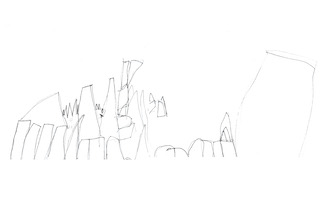
Then the Aloes and Basils exchanged their drawings and photographs with each other and they engaged in the process of analyzing and speaking about what they noticed.
Reflecting on the Illustrations the Basil group shared with the Aloes.
Adriana: What do you notice about their illustrations?
Poppy: I see that they drew the orange triangle in here! Look at this one, because it has 1, 2, 3 sides and it’s on the top of the building. I see the big tall apartment building and I can tell because it has 1, 2, 3, 4 sides.
Levi: I see the big house rectangle right here. ( Looks very closely) This part is the whole thing here. Actually, I was kidding. The tall rectangle is this one. Look!
Adriana: It sounds like you changed your mind after really looking at the drawing closely.
Presley: I see a house that is in the picture is orange and green. The bottom part is the shape of a square and the top part is the shape of a triangle. I also see they focused on the tall big tower. It’s purple, orange and blue. I see two tents. It’s hard to tell from the pictures which part the tents are from.
Reflecting on the illustrations the Aloe group shared with the Basils:
Susan: This is the picture that Uma took from her perspective and what she drew from the angle she was sitting. What do you notice?
Keaton: It looks like she really drew the dinosaur. That dinosaur doesn’t have a tail. How did she draw that dinosaur?
Mira: Is that the one Uma took or I took?
Elliot: That is the big tower that I drew. That is the dinosaur tower.
Susan: That was the perspective from where Uma was sitting and this one is from Dillon’s angle. What do you notice is different?
Keaton: She did it from the side angle and he did it from the front angle.
Susan: What do you notice from the side that you can’t really see from the front angle?
Tallulah: From the front you can’t really see the dinosaur.
Everly: We can’t see the top, only the side.
Asher: I can’t really see the top of this.
Susan: Asher and Everly noticed they couldn’t really see the top that’s called a birds eye view or an aerial view.
Everly: I call that a sky view like in an airplane, you can see the top.
Susan: Let’s take a closer look at the pictures. This is the photograph that Dillion took and this is the one Uma took. Someone noticed Dillion saw it from the front and Uma saw it from the side. What do you notice from the side perspective?
Mars: You can see the little dinosaur. This one is Uma’s because that one has a dinosaur and that one doesn’t have a dinosaur.
Susan: What else did she include?
Mars: The big Eiffel Tower. It’s that thing. That thing. It’s another dinosaur.
Tallulah: No, it’s not. It’s a car.
Susan: What makes you think it’s a car?
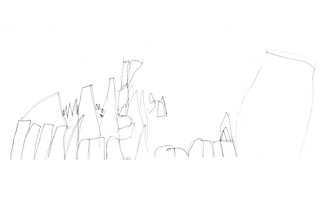
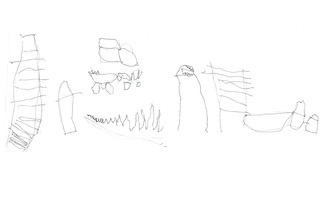
Mars: Because it has tiny things.
Susan: What do you think those represent?
Tallulah: The wheels.
Mars: No, there’s only two wheels.
Susan: In the photograph, you only see two wheels. How many wheels are in the drawing?
Tallulah: 1, 2, 3, 4, 5, 6, 7, 8.
Mars: That’s not it. Cars only have four wheels.
Everly: 4 plus 4 is 8. Maybe there’s two cars.
Susan: Let’s look at Dillion’s drawing. What do you notice?
Mars: That (the car) is that. (pointing at the picture and drawing)
Susan: We saw the car in Uma’s photograph. What do you notice is different about the cars?
Mars: It’s tinier and bigger.
Tallulah: No, they’re crooked. It looks a little bit like my hand (creating a 45 degree angle).
Mars: Like it’s turning. It’s turning this way. Wait, there’s no car.
Susan: Hmmm… this looks like the car because I see the wheels.
Mars: But cars have four wheels.
Susan: When you see the car in the photograph, how many wheels do you see?
Mars: Two
Susan: Why do you think you only see two wheels?
Golda: Because the other two are on the other side!
Mars: But that’s still not the car because that’s three (pointing out the additional wheel on the drawing). Looks at the photograph again. Oh, I think that’s what he’s trying to draw. It’s another wheel!
In reflecting on these experiences, we learned so much about how our children gather their observations to create their representational work. For some of them, it was essential to take the photographs and in order to find the angle that matched the representation. For others, counting and understanding the 3-dimensional structure and creating an accurate illustration was important. Some children were excited about piecing together the story behind the building. As teachers, this was a key moment to challenge the children in representing the structure based on their current observations as opposed to the memory of the structure or what they imagined it could be. With these exercises, we hope to support the group in creating a new habit of mind – to understand what is in front of them by gathering information instead of making assumptions. In doing so, they can understand the perspectives of others, broaden their own, and fully experience a new understanding they create together.