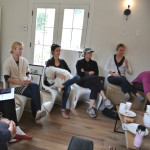
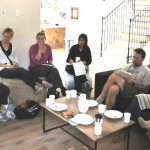
On the 4th of April folks met for what was, as ever, a warm, funny, and extraordinarily enlightening morning. Thanks to the Smuklers for their mega hospitality! NOTE: The next meeting in this award-winning series will be TOMORROW, APRIL 17TH, from 9:30 till 11:30 at the Messina’s, 2215 Ocean Front Walk, Venice, 90291. Meanwhile, here are some notes from the 4th…
Roleen set the theme of the morning by sharing thebook, “Opening Minds” by Peter H. Johnston and the importance of adding the word “yet” to our thoughts and with our children. As in, “I’m not good at drawing… yet.” This brought up making the switch from praising to encouraging. We all fall into the trap of “good job” as opposed to noticing why was it good and what about it was good. As parents we seem to comment on everything and sometimes it is ok to not say anything. Instead of praising everything that they do, be a reporter and say what you noticed, “you put one foot in front of the other foot on the balance beam”. Roleen says, “Say what you see, not judge what you see.” Children can feel a lot of pressure to perform because of the constant praise and applause. This can lead a child to question their abilities and to rather not try if they can not be the best. The kids who do really well in life realize that the challenge is the thrill and this can be modeled. An article by Po Bronson, “The Inverse Power of Praise” was recommended on this topic.


Roleen set the theme of the morning by sharing thebook, “Opening Minds” by Peter H. Johnston and the importance of adding the word “yet” to our thoughts and with our children. As in, “I’m not good at drawing… yet.” This brought up making the switch from praising to encouraging. We all fall into the trap of “good job” as opposed to noticing why was it good and what about it was good. As parents we seem to comment on everything and sometimes it is ok to not say anything. Instead of praising everything that they do, be a reporter and say what you noticed, “you put one foot in front of the other foot on the balance beam”. Roleen says, “Say what you see, not judge what you see.” Children can feel a lot of pressure to perform because of the constant praise and applause. This can lead a child to question their abilities and to rather not try if they can not be the best. The kids who do really well in life realize that the challenge is the thrill and this can be modeled. An article by Po Bronson, “The Inverse Power of Praise” was recommended on this topic.
Roleen used the example of learning the right time to walk in front of a swing as a metaphor to how to be in a conversation. When is it time to listen and when is it time to respond? Children are learning how to be a part of a group. Some parents commented that they are noticing that their children are competitive and that is ok. At this age children may feel like they need to save face and a sometimes they do this by “lying”.
Discussion about making a commitment and sticking to it. If my child wants to sign up for an activity and does not like it should they have to stick with it anyway? Roleen says that before you start anything go and check it out first on your own so that you can discuss it with your child. Find out what the expectations are. Will there be a uniform? Is it outside? What is expected? Have a discussion about what will be involved ahead of time. The dilemma afterall this is, “What if after signing up they don’t want to do it? Then they need to be a part of the problem solving and if dropping out is not an option, then that can be written down as an idea. Remember, the intention of problem solving together is that the end resolve is one that is acceptable to everyone (and recognize that this may be a timing process and one that needs to be revisited if necessary). Perhaps one of the ideas is to talk to the coach/teacher, etc. Distinguish between what is their nature and what are they just avoiding.
On Death. Recently a family has experienced the losses of close friends. On the blog, under articles there are a lot of resources for specific age groups. Roleen recommends that we have to figure out how we feel about death, first. What do we believe to be true for our own families? When the death is of someone who is very close to the child and the household is really affected, think about ways to talk about things that are still the same (during this time when everything seems “all over the place” and emotions are unpredictable). Sameness can bring comfort. “What are the things we will always remember about….” Remind them of routines. . “When we wake up in the morning, I’ll still make you pancakes for breakfast, Fido will still eat his cereal and go poop in the backyard”, etc. Find out what they know first before offering information and if you have been avoiding it, a good opener can be, “A lot has been going on lately and we haven’t really been talking about it”. Making books for kids in times of crisis are really effective, a memory book which can be handmade and done just stapled together. Remember the ability of them to heal us. If going to a memorial, let them know in advance that people may be crying because their sad but laughing because the memories we have of people are good and fun and funny. It is really important to let them know that people think differently about death and that’s ok. Roleen says, “The whole key to this is processing our own stuff…. read articles, revisit them anytime… talk to someone”. Children may ask, “Are you going to die?” one answer to this may be, “I am PLANNING to be alive for a long time. That’s my PLAN”. Betsy Braun Brown’s book, “Just Tell Me What to Say” has a chapter on death.
On Behavior:
Three reasons people misbehave
1. An unmet need.
2. A lack of a skill.
3. The wrong fit.
Behaviors mean something, address the real need. When a child “misbehaves”, go back and find the root or cause of the behavior. Look at your lifestyle, has there been a change? Are you not spending time with them? A change with work? A break in routine? Visitors? Even good things can be a challenge to kids. Have a one-on-one conversation with them separately about what’s going on. Stop stepping in too soon, give them the option offinding their own solution. Be a model for them of what you want, tell them you would like to sit down and discuss it, let them be a part of the conversation. Acknowledge thatyou have feelings, too. Let them know that you’ve never done this before and remember that as 3, 4 and 5 year olds it is their job to save face in order to get their needs met so they may “lie” to you about their behavior. Avoid asking questions that you already know the answer to. One of the parents shared her experience of her child taking a necklace home that she knew belonged to her child’s friend. Instead of “Did you just take that??” (she already knew she had), say, “That looks like Mary’s. We have to let her know you have it.” Remember, that If you do blow up, come back later and talk about it, “I was really upset back then. I’ve had time to calm down and think clearer…”. The pause button is really huge. Take a breath. Be self-compassionate. It’s ok to admit mistakes. Model taking a break to your children, collecting yourself, taking a pause. Ask them for their help, it is meaningful work for them. Later, when they need to talk about deep stuff, they will come find you because you have given them the foundation for this kind of communication. Recognize that you may be horrified when your children are not who you want them to be (yet!) and remember to ENJOY the amazing parts of your children.

— Documentation Committee
1 comment for “Coffee with Roleen 4/4/13 notes”