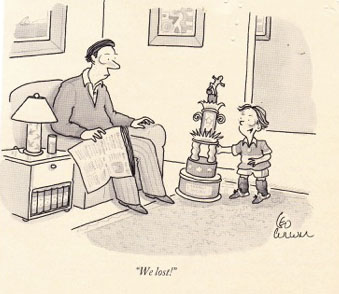
“WE LOST!”
Thanks to Karrie for hosting another great morning with Coffee with Roleen. Those who were able to attend were: Sammy (Sy, WW) – it was her first Coffee with Roleen, Jill (Riley, EW), Patty (Jasper, EW), Theresa (Ava & Theo, WW), Hana (Kyler, WW), Sabrina (Felix, WW), Adam (Bennett, EW).
– We began by going around the room introducing ourselves. Jill shared her story/journey about cutting down on her work hours to spend more time with her daughters. Her AHA moment came from reading “Blessings of a Skinned Knee” by Wendy Mogel. This led Roleen to talk about how our culture focuses so much on what we don’t have and having the guilt not to do more.
– Roleen: We get overwhelmed by what we see and though we may not want to, we get caught up in the hustle bustle and competition to keep up, but instead of focusing on what we see, it would be wise to start listening to what we hear. Close your eyes and just listen sometimes. Especially at a birthday party! A party with a bouncy house may seem like a lot of fun, but stop and listen to the children. Is everyone really happy? It’s really ok to slow down and simplify and children will more than likely repsond to the shift.
– The book “Six Stages of Parenthood” by Ellen Galinsky talks about how toddlers and preschoolers who are in the Pre-Operational stage of development still think they are connected to you (the parent) and that you know what they’re doing and where they are at all times. Elementary school is when your children can really respond to “What did you do today?” They understand in the Operational stage of development that they are sharing experiences beyond you.
– A lot of parents today are trying to figure out how to set limits for their children but struggle with sounding/being “authoritarian”. They remember that kind of parenting and don’t want to model it but don’t quite know how to discipline in a respectful yet firm way. With that, there is a tendency to be permissive and inconsistent and this leads to instability for the children. This is also true for children with authoritarian parents. What we want to see ourselves becoming is authoritative parents. Consistent firm limits where children understand their role is a good balance and offers safe boundaries.
– Three reasons why children misbehave:
1. Unmet need (ie tired, hungry)
2. Lack of skill
3. Wrong fit (ie forcing a child to sleep when they are not tired or trying to get them to be still when their brain is saying “move”)
– Tips for transitioning to kindergarten:
- Give your child a visual (ie diagram of campus, photos of school) of what to expect at kindergarten and on the first day of school.
- Write down what they should expect, this will ease the transition. But this means that we have to be the researchers to find out what will happen so we know how to prepare them (and ourselves!)
– Roleen reminded us that we cannot ignore our emotions and the feelings we have but to ensure that they don’t overtake our ability to move forward, it’s important to find techniques that will support the process of passing through them. She shared with us that when she gets overwhelmed, she often writes down her emotions on a piece of paper and draws a square around them. This allows her to recognize that the feelings are present and helps her move forward in a clearer way with the tasks at hand.
– Theresa brought up an issue she is currently dealing with. Ava has been acting out lately because she thinks it is unfair that, Theo is getting recognized (and praised) for doing things that she has been doing all along. This lead to a discussion about how kids want to be noticed. As a matter of fact, all people (children and adults) want to be noticed. It’s really ok to talk with children with leading statements like, “I’ve noticed that when. . . ” Too often we don’t want to replay a scene and try to ignore it hoping it won’t happen again. And yet, you know it will. Addressing the problem when moods are light is a good time to revisit scenarios so all parties can be a part of the solution for next time.
– Hana has conflicting feelings about Kyler going to Japanese school every Friday. Kyler hates going every week. Hana recognizes Kyler’s unhappiness, but at the same time, she thinks she knows what is best for Kyler and that Kyler will be grateful down the road for knowing how to speak Japanese. Hana hated Japanese school too but is now extremely thankful for being fluent in Japanese. Should Kyler continue to go to Japanese school? Roleen asked us to think about what our end goal is in any new situation. In this case, if the end goal is for Kyler to learn Japanese, then what are some possibilites that might work better for her. She suggested that Hana do some research on the school and find out what Kyler’s day is like there. It’s very likely that she may discover that this particular school may not be the right fit for Kyler’s learning style right now. There is always more than one way to reach a goal and in this case, there may be other options for Kyler to learn Japanese.
– Hana also mentioned that Kyler is gaining a lot confidence lately and at the same time she is exhibiting new insecurities. Roleen reminded us that children experience the same insecure feelings we do when we are not sure of new situations. At school, it’s a time for changes to happen and there is a lot of discomfort in not knowing something confidently. It’s also a time when children start bridging out and start up new relationships because interests change. That’s hard. Remember what we said about about the three things that bring on “miss” behavior. Unmet need; lack of a skill; wrong fit. And remember, children usually can’t tell you why they are feeling the way they do so asking them is almost pointless. You have to observe, listen, validate, and don’t forget to talk with the teachers about what you’re seeing. They are great resources for us.
– Self esteem => confidence
– Book suggestion: “Parenting from the Inside Out”, by Dan Siegel and Mary Hartzell
– Adam said the best thing about NSW is that it is “low-key”. This is what makes NSW so special.
– The meeting ended with a discussion about how to improve communication between NSW and the parents and prepping for the new school year.