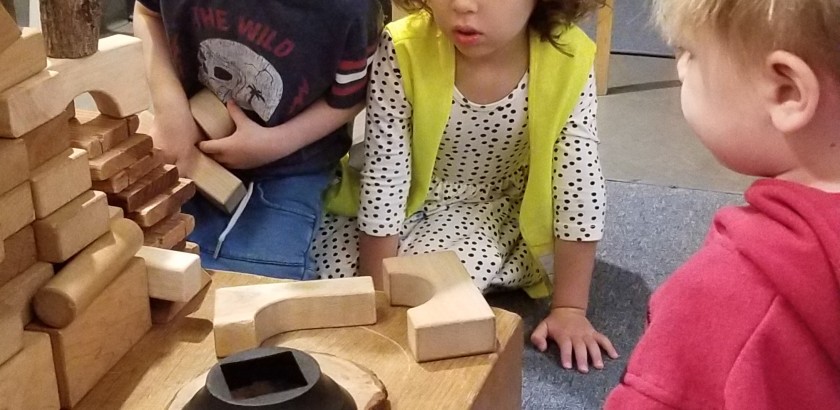
In the West Wing Building Space, we’ve been supporting children as they build their understanding and develop strategies to practice flexibility. At the beginning of an appointment, we routinely brainstorm ways we can link ideas together and consider how the group might feel if one person declares, “This is mine. You can’t add to it.” This exercise primes the group to work collaboratively. The following are a few episodes of play in which a group of children found different ways to practice flexibility in order to work towards a common goal.
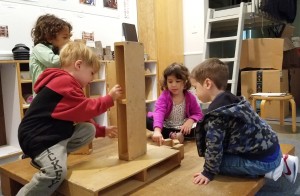
Crosby: We’re making a cool boat.
Arrow: Do we need these, Crosby? (holding cylinders).
Crosby: Yeah, put them there.
Arrow: I’m going to put this one here. I have an idea. How about we put the dragons who want to eat the boat here? They smell it, and they will leave because it’s spicy and smokey.
Crosby: We need the smoke and no dragons.
Arrow: I see dragons in every water and every ocean.
Crosby: There are no dragons in oceans.
Arrow: They fly and when they see a boat, they’ll say, “this one” and eat it, and the blasters come up in the sky.
Crosby: Oh yeah, and the smoke will come up in the sky too, and the dragons will fall off. Do we need these? (holding tiles)
Arrow: Yes, this is candy and they can’t eat them, so we need to hide the candy.
Crosby: We need no sinkholes because the boat will sink into the water. The boat touches the water, and it will sink.
Arrow: No, if the boat touches the water, it won’t sink. If we get close to the reef, the reef gets a hole in the boat, and the boat is going to sink because it gets too watery.
Crosby: Oh yeah.
While Crosby, Leo, and Julian are working on the back of the boat, the idea of a sinkhole reemerges when the group notices a gap between two blocks.
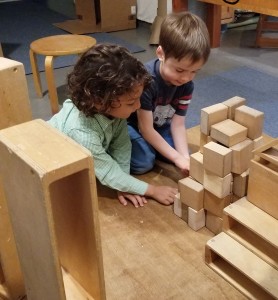
Crosby: Cover it!
Julian: Hide everything!
Arrow: I’m going to hide.
Teacher Susan: Arrow, I think they’re trying to hide the sinkhole. Did you see it?
Julian: Put everything in the hole.
Crosby: Uh oh, you fix it because I’m going to fix the other one.
Leo notices the blocks wobble as Crosby makes repairs.
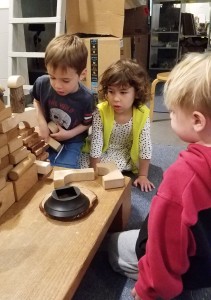
Teacher Susan: You might need to give them more information.
Leo: I don’t want you to sink it. Add it slowly.
Arrow: Look, we fixed it.
Leo: Look, a little hole is a sinkhole.
Crosby: Only the bottom is the sinkhole.
Arrow: Look, there’s the sinkhole in the bottom. It’ll sink down into the ocean.
Leo: Don’t worry.
Crosby: Don’t worry if it sinks. I’ll push the green button and it’ll go back up. The water won’t come in here because I made something. It won’t get through here because it’s too hard to get in.
While I observed the group in action, I noticed each found their own ways to practice flexibility. Flexibility becomes possible when we’re able to listen to others with the intention of understanding their thoughts. Once a common understanding is shared, it’s easier to stretch out our ideas to make room for others. Evident in this experience was the children’s willingness to listen to each other, as well as gather input from their peers by stating, “I have an idea” or asking, “Do we need these? Where can I put this?” I also observed how listening with understanding turned to empathy when Crosby and Leo recognized that Arrow might be feeling worried about the possibility of the boat sinking. This connection allowed Crosby to come up with a creative solution that aimed to alleviate those feelings. As we continue to learn together as a community, we wonder what emotions come into play when the children practice flexibility. How can we make visible the children’s developing strategies in our classroom? -Teacher Susan