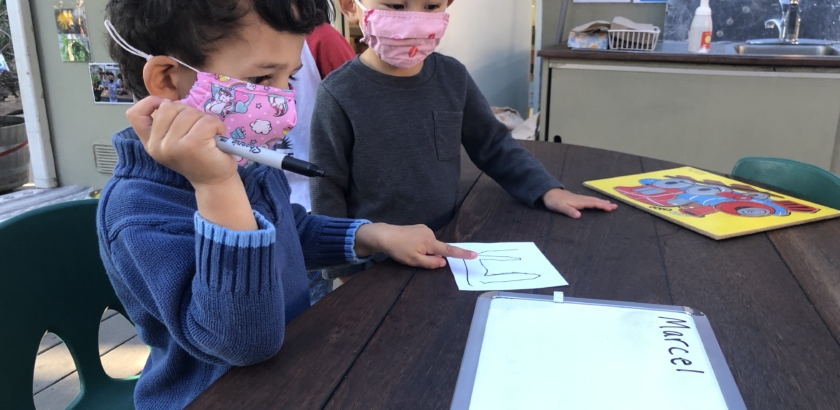
In the morning, after the Dandelions wash their hands and put away their backpacks in their cubbies, we offer an invitation: “Let’s make your mark!” We offer the children a black sharpie for its thick grip and a piece of white paper. On a small whiteboard next to the paper, we write the child’s name, using upper and lower case letters.

Emma: I wash my hands and then I make my mark.
Ana: Is it my turn? Can I make my mark now?
Emma: I’m still writing my name. See? E-M-M-A.
Ana: I have an A.
Dana: Arya has an A too. In fact, you and Arya have two As in your names!
Leon: This looks like an L to me.
Eddie: An L for Leon. And an E. I have two Es in my name.
Marcel: I start with an M. I’m looking at the M right now. Now I’m looking at this one.
Dana: The R.
Cary: I have an R. Is it my turn to make my mark?
Marcel: I’m almost done. I’m looking at the snakey line here.
Dana: It sounds like the lower-case L at the end of Marcel reminds you of a snake!
Evyn: I don’t have an L in my name.
Marcel: But I do.
Zoe: I want to do my name by myself.
Spencer: And then me. Here’s my S.
Dana: What letter comes next?
Spencer, pointing at the P: I can draw it.
Dana: The P. It makes a “p” sound.


In the West Wing, we incorporate literacy and letter awareness in a playful way, without putting any pressure on children. Making your mark is something that everyone can do. Some days we might see letters; some days we might see shapes; some days we might see scribbles. In any case, the children’s comfort and confidence grows in their ability to sit down with a writing tool and sign in for the day.
As the children get more familiar with this routine, we will start introducing a sign-in sheet like the ones in the East Wing: one page per child, with one line for each day of the week. This will allow the children to increase their autonomy in being able to make their mark independently of a teacher, and it will allow us to observe and track how their writing skills develop over time.

This routine of making their mark is also supported by other fun ways that we incorporate literacy in our classroom. Earlier in the winter, the Dandelions created a clay alphabet and they took turns spelling and then photographing each other’s names. These letters are available in our Mini Studio space for play, along with the children’s laminated head shots.


Also in the Mini Studio, we have laminated letters that children use as a template for loose part exploration. Using loose parts — like pom poms, glass stones, tiles, crystals — to create the shapes is another way that children learn how the letters are formed.


At Morning Meeting, we play a welcoming game called “Around the Circle.” We start by singing, “Around the circle round again, round the circle round again, round the circle round again!” Then, we hold up a piece of paper with a name on it. When the children figure out which child it is, we call out their name, we whisper their name, and we clap (the syllables in) their name. In the beginning of the year, we would also show who was next by showing that child’s photograph. Now, however, the children are able to read the names on their own.

Flora, holding up Olivia’s name: Here’s our next Dandelion!
Emma: Olivia!
Flora: How did you know this was Olivia’s name?
Emma: Her name starts with an O.
Cary: An O looks like a circle.
Flora: That’s right. Here’s our next name.
Eddie: Arya!
Emma: No, that’s Ana’s name.
Eddie: It has two As.
Emma: So does Ana.
Flora: Both Ana and Arya start and end with As.
Emma: A-N-A is Ana.
Flora: That’s right. This is Ana’s name. Okay, here’s our next Dandelion.
Emma: Eddie!
Eddie: That’s Eddie! Me!
Spencer: Eddie! Eddie! Eddie!
Zoe: Eddie!
Flora: How did you know that this was Eddie’s name?
Emma: He has two Ds in his name.
Marcel, pointing at Eddie’s cubby: And his name is right here!
Flora: You noticed that this is Eddie’s name. We have three Dandelions whose names start with E: Eddie, Evyn, and Emma. Let’s see who is next.

We recognize that there are so many ways to introduce children to letters and literacy in the West Wing, and we see how successfully these different strategies lead to new awareness and understanding. We will continue to foster this learning through playful exploration.