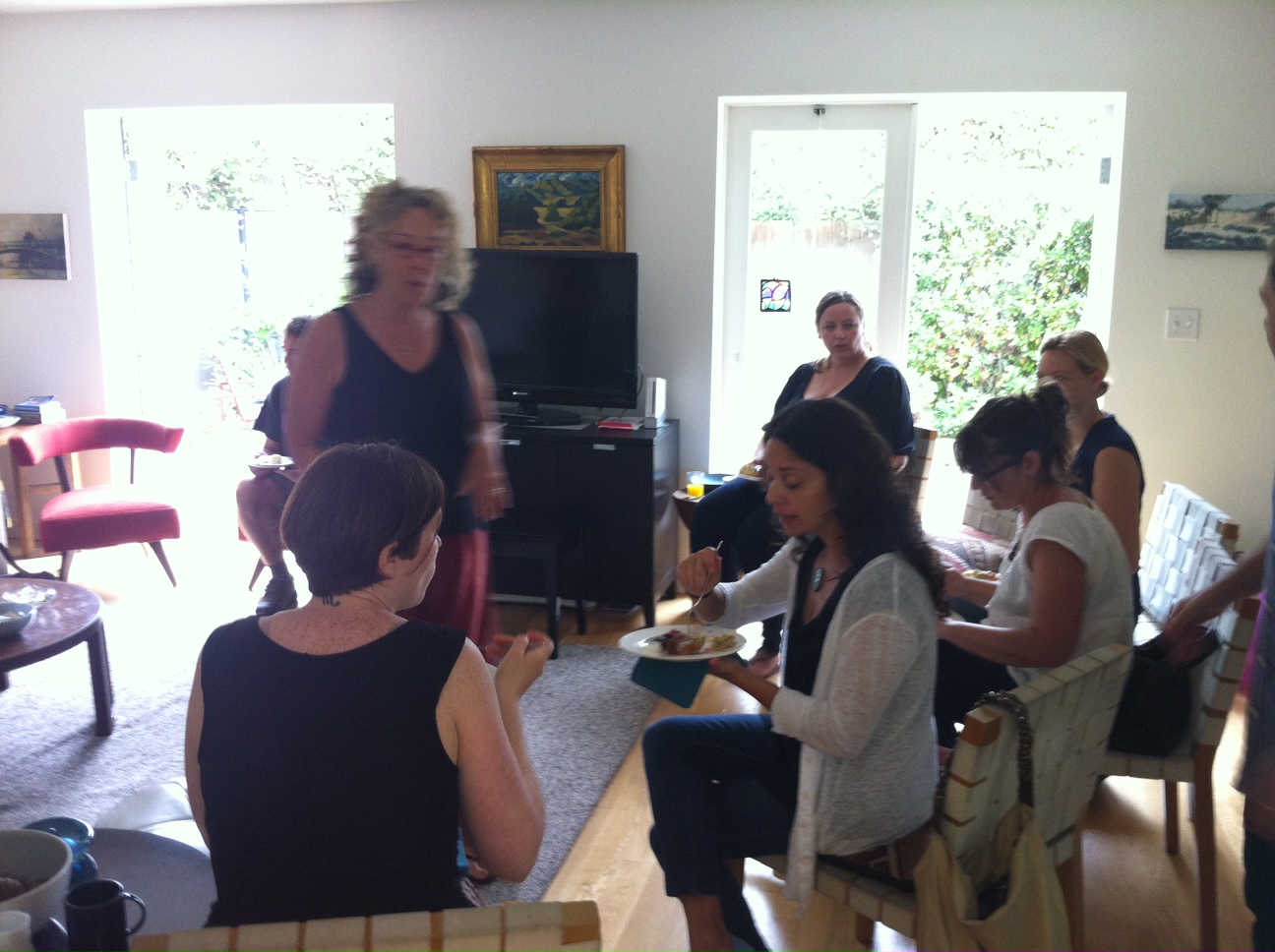
On the morning of August 23rd, New School-West parents filled every available chair at Jeff and Michael Stuno-Pervorse’s place in Venice (they of Imonie, EW) for the introductory installment of Coffee With Roleen. Years ago teachers observed parents gathering and lingering around the school after dropping off their kids, swapping experiences and ideas. One day someone said Let’s all go to my house!, and thus was born a tradition. The school wants to make sure parents get the support they need, and these informal meetings offer a place to process all these emotions and challenges in an environment of respect, without judgment. Hardcore practical gems and deep validation. Plus food. Plus laughs. Come to one of these, you’ll see. Every “Coffee” follows the unpredictable path of whatever comes up that morning — here’s a somewhat scattershot shorthand from the 23rd. (Incidentally, all notes from past meetings are archived on the blog. They are no-kidding substantial, really worth your time!)
— Children’s job is to get their needs met, they’ll mess with you to get their needs met, which is different than being manipulative. When something negative is manifesting, they may just be looking for a “way in”. Try to identify their need in that moment.
— Firm, secure boundaries are great for children. We feel mean if we “discipline” — possibly remembering OUR childhoods. It is a disservice to not teach them how to be citizens of the world. Example: naptime at school has small parameters, they are part of a community, they need to be respectful to the people around them.
— Expect them to be maniacs at home after school. They are working so hard at school, it looks like fun, but it’s really HARD WORK, they are learning so much, and they know they can fall apart with you, in the same way an adult might push through a tough experience and then break down after it’s over.
— Listen to your gut. You don’t need to necessarily ACT on it right away, but listen. Books and theory can be overwhelming.
— “W-H” questions are often highly abstract and all but impossible for a child. “Why are you acting that way?” “What happened today?” Questions like these shut down communication. Try: “Have you noticed your body is really crazy? I get what’s happening…” NOTICE things, be a REPORTER. These are concepts that come up a lot.
— Reconnecting with you after school is critical. And they will do something negative because that’s a way to get your attention. If they’re not negative, then you will probably go off and do some dishes…. Say: “I’m going to sit with you for a minute, eye to eye, just you and me.” It only takes a couple minutes.
— Regarding “insanity in the morning”, as one mom put it. Helpful to meaningfully reconnect the night before, and be watchful how hurried you are, it transfers to them. “We’re going through some changes right now… Have you noticed mornings are crazy? How can we make it better? Let’s write down some ideas, make some rules that will help everybody. Do you have any ideas?” And absolutely right down every idea, and then post them on the wall. Children want to be heard, acknowledged, noticed.
— Another mom said “yeah, but what if you’re IN it, what if the insanity is happening NOW?” Demonstrate, model what you do to calm yourself. “I’m going to sit for a moment and breathe because I’m getting upset and I can’t think.” Just STOP — they will be surprised. Get grounded, literally, by getting DOWN. “I’m not leaving, I’m here, but I’m going to be quiet for a minute.” The key not to engage for a moment. Sometimes we say too much. Then, later, go back and talk about it. “Do you remember what happened last night? I had to lie down. That works for me. How can I help you?” Roleen shared a story of walking into a particularly insurmountable classroom situation and, at a loss, just lying down on the floor. The children stopped, came over, investigated, got a tablecloth, and had a picnic on her.
— PATTERNS are important. Lying down could be a pattern. Having peas on their plate could be a pattern. Don’t have the peas there only one night. The next night, add carrots, but keep the peas, the peas should stay. It’s harder if things are always new.
— Jamy (Sasha F, EW) recommended “The Whole-Brain Child: 12 Revolutionary Strategies to Nurture Your Child’s Developing Mind”, by Daniel Siegel and Tina Payne Bryson. The book presents, among many other topics, different kinds of meltdowns, to be dealt with differently. Also the idea that you can talk with them about what’s happening in their brain, and then they can even TALK to their own brain, say, “Brain, you don’t need to think about this anymore, you don’t need to be afraid of that.” This is an example of giving them intrinsic skills instead of fixing everything for them.
— Host Michael recommended “THE DIFFICULT CHILD”, by Stanley Turecki which explores different temperaments, with strategies tailored accordingly. Jamy also pointed out how the word “difficult” might be misleading… an alternative angle might be “you are amazing, I’m not trying to change you, I’m trying to figure out what your needs are and how to meet them.” Our culture seems to reward compliance… but everyone is different. On this note, Roleen pointed out “Fairness does not mean equality. Fairness means giving each individual what THEY need.” A larger life lesson there, for sure…..
— We have to help them know how to RESPOND to the world.
— Often “bad behavior” is just trying out something they’ve observed.
— Socializing with their same-age peers is the hardest, because their role in comparatively unclear. They are not the older one… they are not the younger one… they have to negotiate. This is a curriculum at school, socializing, entering play. Considering “What do you want other people to know about you? What do you want to know about them?”
— “Shy” is also a protective label, a dangerous label. It excuses them from ever engaging. Laura (Jasper, EW), recommended the book “QUIET” by Susan Cain, about the power and necessity of introverts. Roleen has observed that often it is the extrovert who needs the introvert more than the reverse, the extrovert may in fact be the less secure of the two.
— A child’s best friend at NSW is moving away. Roleen reassures… the school does a lot of work with this kind of situation.
— The school has an open door policy because of course it must… but parents quickly learn that it’s not good for their children if they hang around, too many goodbyes! They are supposed to cry when they’re leaving, it’s ok, it’s healthy attachment.
— Playdates can be 30 minutes, or an hour, they don’t have to be 3 or 4 hours.
— Regarding parenting styles… there’s a spectrum which often appears on applications to private schools with “AUTHORITARIAN” at one extreme, “PERMISSIVE” at the other, and “AUTHORITATIVE” in the sweetspot middle, which is about not simply giving them what they want, but giving them what they have a right to have as a person within the idea of “who are we as a community.” Example, going to a restaurant: “There need to be rules, it’s not ok to scream and run around, you can’t pour sugar on the floor.” (Preface the outing with this discussion.) “If you can’t follow these rules, then we are going to have to leave” (or another meaningful consequence).
— … and more about consequences. Children have to be in on them. “This is not working as a family, we have to stop this behavior, what can we do? Let’s all agree.” And, again, write down the ideas and post them. Book recommendation on this by Lauren (Ben H, WW): “CHILDREN: THE CHALLENGE”, by Rudolf Dreikurs
— going into a toy store… Wishlists are great. They mean “I heard you.” Another parent-tested book “THE BERENSTAIN BEARS GET THE GIMMIES”.
— … a lot of discussion about bedtime, how to help them get to sleep. Roleen talked about explaining to them ways to self-soothe, for example guided visualization. Many parents offered ideas/suggestions/warstories. Audiobooks. There are also
some great DVD videos from Thich Nhat Hanh, including “Mindful Movements: Gentle Contemplative Exercises with Monks & Nuns of Plum Village”.
7 comments for “Coffee with Roleen notes”