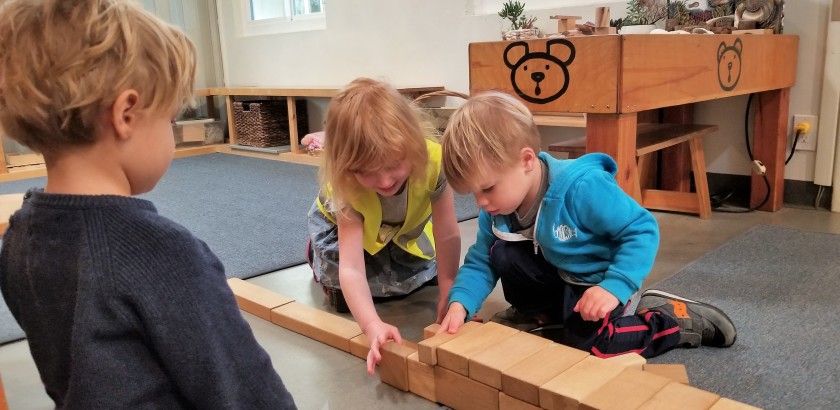
The West Wing Building Area is a space where children have opportunities to collaborate. Sometimes these experiences begin with a common idea and other times children begin with individual ideas and are challenged to figure out ways to connect with the group. During a morning appointment, Coco begins to create a sidewalk next to the platform as Crosby and Estelle work together to build a tunnel nearby while Harrison observes.
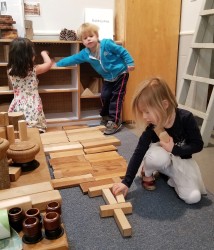
Crosby: We can make a tunnel, right?
Estelle: Yeah, and a pathway.
As the tunnel begins to take shape, Crosby lowers his head in front of the opening.
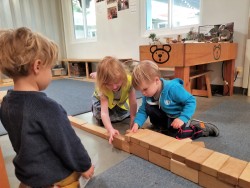
Crosby: I can see all the way through.
Estelle and Harrison follow suit.
Harrison: Me too!
Estelle: Harrison, it’s not finished yet. The walls have to go all the way there (pointing to the end).
After laying down a few more blocks, Coco decides the sidewalk is complete.
Coco: I’m done here. My project is done.
Teacher Susan: Coco, did you notice what the group is working on over there? I wonder how the tunnel and sidewalk can work together.
Hearing this, Crosby brings a block and adds it to the sidewalk.
Crosby: We can connect it!
Coco: Yeah, this is our project!
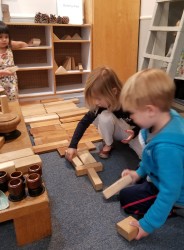
Mabel observes from the Exploration Room and decides to join the group.
Mabel: I’m building, too!
As more pieces are added, the sidewalk meets the tunnel. Coco then notices Mabel laying fabric on top of the sidewalk.
Coco: No, that can’t go there! (Taking the fabric and throwing it on the ground).
Mabel: Stop, stop, stop!
Teacher Susan: Mabel, let’s give Coco more information.
Mabel: I want to build, too.
Coco: This is not your project. This is our project.
Teacher Susan: Coco, how do you think those words made Mabel feel?
Coco: It made her sad.
Teacher Susan: Remember how you first worked on the sidewalk and then you, Crosby, and Estelle connected it to the tunnel? First, you were calling it “your” project and then it became “our” project. How could you welcome Mabel so she can be a part of this idea?
Coco examines the shelves, gets two blocks, and hands them to Mabel.
Coco: Mabel, you can add these.
Mabel: Okay, I’m going to add these here (smiles).
Experiences like these show the learning possibilities when children are challenged to look beyond themselves and their own ideas and move toward interconnectedness – a process that values relationships. It also leads me to question the clusivity of words. In one context, the use of the word “our” seemingly feels inclusive; yet when this word is used within the context of differentiating “ours” from “yours,” the consequence is exclusion. When such scenarios arise, the practice of perspective taking and rethinking has the power to transform the exclusive “our” into the inclusive “our” and seeks to include new members entering a group.