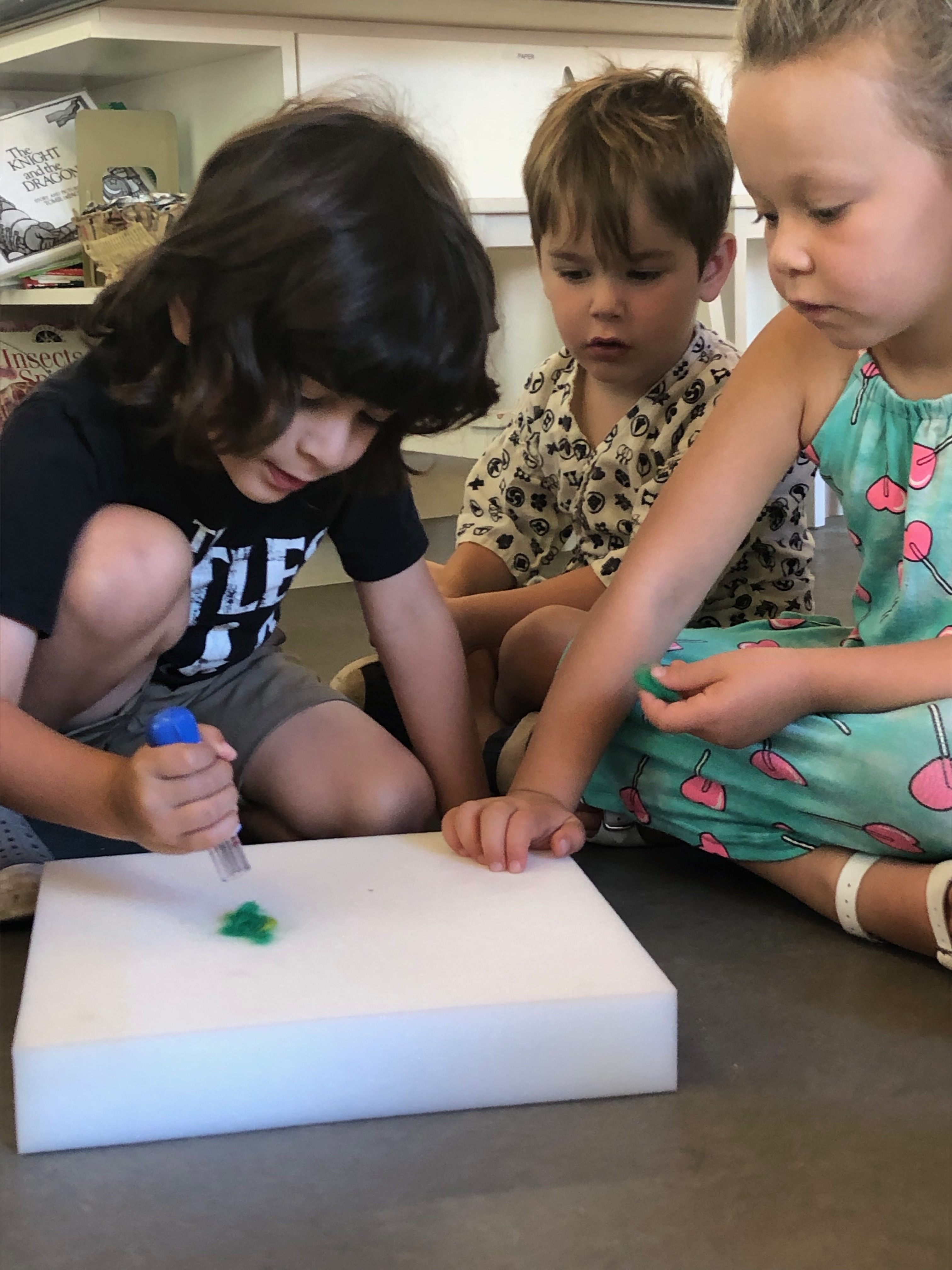
With an interest in cacti, we recognized the children identifying with their shapes and textures. We considered materials that could be used to express their interest while also maintaining an intention for building ways to weave the children’s relationships together. Needle felting is a process that uses barbed needles to interlock wool fibers to form a more condensed material. Felting offers a sensory experience as well as an opportunity to use a prickly tool – a perfect expression of their cacti personification.
First, the wool was introduced and while being explored, the children’s initial reactions were to rub it on their skin and faces and pull at the fibers. They wondered where it came from and how it got its color.
Jude: I know where wool comes. It comes from wolves.
Hendriks: No. It’s from sheep.
Juliet: But someone put paint on it.
Kirby: It’s called dye.
Next we introduced the felting needles and a foam surface on which to work.
As the children tested the wool with the felting needle, the image on the foam began to remind them of a cactus.
Lily: I can draw what it could look like.
Juliet: I want to add. (Receiving the passed single paper from Lily, she represents another cactus with the sketching pencil).
Diego: I have an idea. (He draws a circle inside the cactus that Lily illustrated). It’s a home for the birds.
The group becomes engaged and continues passing the single paper around the table and each child watches while another adds an idea. Together they watched a cacti scene emerge. The group discussed the possibilities of how to share the work and I introduced the idea of transferring the images onto a larger canvas. This would allow for all the ideas and add the opportunity for other children to join in. We made a plan to meet again to work on the transfer.
Though the initial intention was to introduce needle felting as a way to bring a new medium to this texture-loving group as well as to bring in a ‘prickly’ tool, I was soon reminded of the importance of working together on a common piece. What stood out was the fluid pace at which this group worked on a common idea that incorporated the skills of sharing ideas verbally as well as listening to another’s point of view. More significantly, I was reminded of the importance that collaboration plays in initial introductions. Witnessing this group pass a single paper around may not have been the case if each child was given a single foam on which to work. This canvas will ultimately challenge the East Wing in their relationships as they negotiate placement, story, and materials and we anticipate being just as captivated by the journey as they are with the subject. Cindy