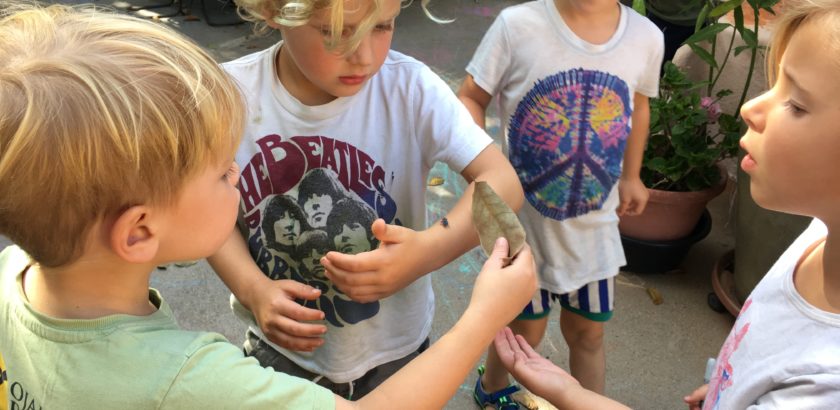
The children are curious about living bugs and the teachers are curious about what exactly drives this curiosity. Is it the living creature’s nature? Is it the feeling that comes to you as you encounter a bug? Is it trying to understand your role as a child with nature? Is it all of these pieces together? We investigated.
Teacher Adriana: I noticed you really enjoy looking for spiders.
Emilio: We want to capture it and see it. Then we give it back to nature.
Adriana: I wonder how the spiders feel when we capture them.
Grey: We only get them for a little bit and then put them back.
Hayes: It’s a little scary to get them, right?
Harrison: I’m practicing holding one, but I still get scared.
At this moment, we still had small containers where the children can put the spiders as they observe them. I decided to remove the containers and create a more intimate moment between the bugs and the children to research one of our questions about how an encounter with bugs feels and if that were the draw.
Jake: Oh, this is more hard. I’m a little afraid of holding a spider.
Grey: I can’t do it. I need a container.
Adriana: I’m curious. How come we feel like holding them?
Grey: We want to give them a better home.
Paisley: Yes, that’s a dangerous home right?
Grey: Yes, that’s a bad home.
At Reflection Meeting, we went further into the idea that children felt they had a role in the spider’s life and gathered ideas on what they meant by providing a better home.
Wally: A better home is a little hole with some water.
Hayes: it needs to be outside.
Jacob: Water will actually make spiders die. Spiders can’t swim.
Fiona: It needs to have spider webs.
Lily: A home is a house and inside, it has spider webs.
Isaac: They need to hide under dirt.
Poppy and Caitlin: A bug home is a cup with dirt.
Arrow: It has a stove, spider webs, sofa.
Estelle: Furniture.
Leo: It needs to be out of bricks.
Poppy: Leo, they can’t breath.
Chase: I disagree with the cup idea. It needs to be outside.
Jake: A T.V
Caitlin: What if they don’t have a family and it’s raining?
Paisley: What if their family died?
Arrow: A big forest isn’t a good home. What if they get lost?
Crosby: Dark, a different world. Away from their family.
Wally: Lost in the woods. They don’t have a family. They need a family to protect them.
Isaac: Thunder!
Ava: All the animals in the woods don’t like lighting.
Leo: Bugs, lost outside, died.
Kayden: What if the bugs have no legs?
Julian: They need a flashlight and batteries for the flashlight.


By giving the children the space and time to explore their bug interest, we took detailed observations that inform us on how to deepen their curiosity. As we reflected together on what a better home for the bugs looks like, we are able to see the levels of empathy that the children hold for the bugs. As Dan Siegel explains in his research, there are five types of empathy:
Emotional/emphatic resonance- You are effected by the feelings of another person.
Perspective taking- Putting yourself in the skin of another person.
Cognitive empathy– Using your previous memories/experiences. Memory, emotions, and the judgments all influence our present moment’s experiences.
Empathic concern same as compassion: Feeling the suffering of others. They then have to take the suffering/concern and imagine what they can do now to make them feel better. Then you actually do something about it.
Emphatic Joy: This step is where you feel joy for the success of others.
As a school culture, we see the care that children have for bugs. They feel happy as they see the bugs moving around the spaces and when a bug struggles to survive, they feel sad for the bug. When the children try to hold a bug for long periods of time, we ask them how the bug might feel and in this process they begin to take perspective for the bugs. Some of the children who are more invested in the bug interest begin to create a ‘habit of knowledge’ that supports them to make a decision about how they interact with the bugs. These children are showing a level of cognitive empathy. As they being to think about what kind of house to build for the bugs, many of them are thinking about what bugs need to survive such as dirt and webs, and others are thinking of and relating with their own personal experiences by designing a home that also gives them a type of protection such as a roof. By continuing to focus on our bug interest, we are growing more sensitive for bugs even though we haven’t had the same experiences as the bugs. This practice in relating to something that you recognize as different from you helps you to make connection to the other and helps to form a healthy community. Adriana and Kristin