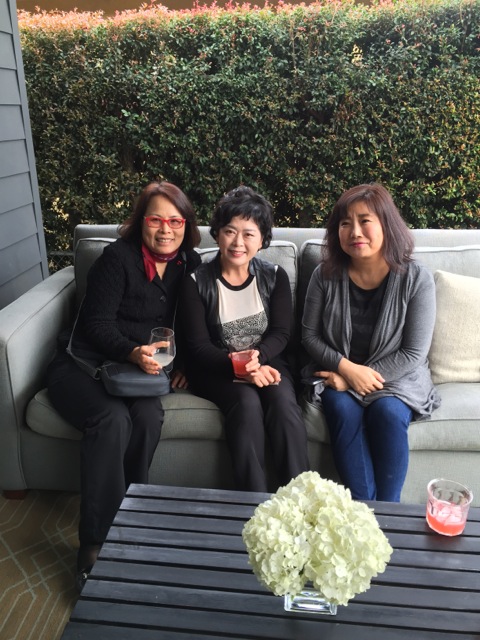
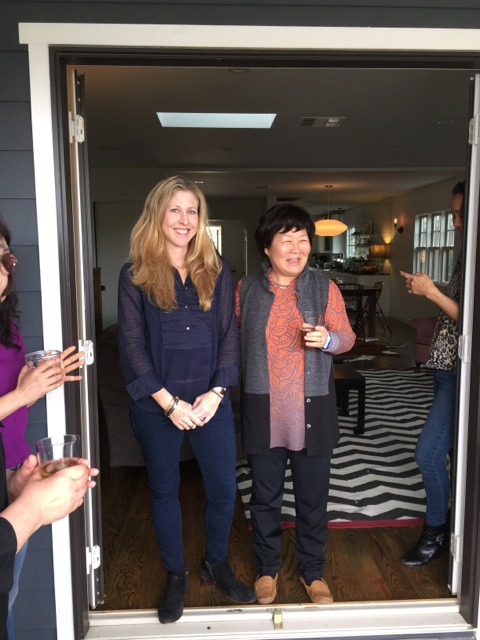
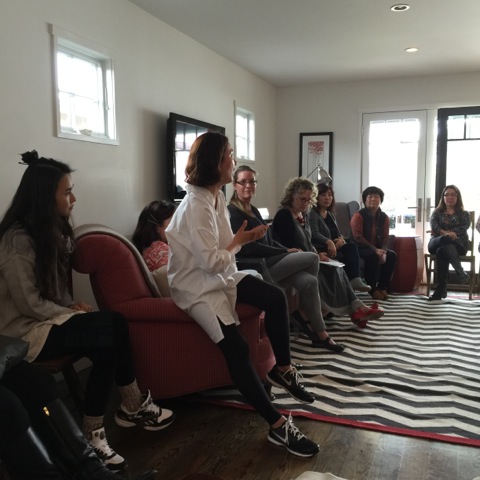
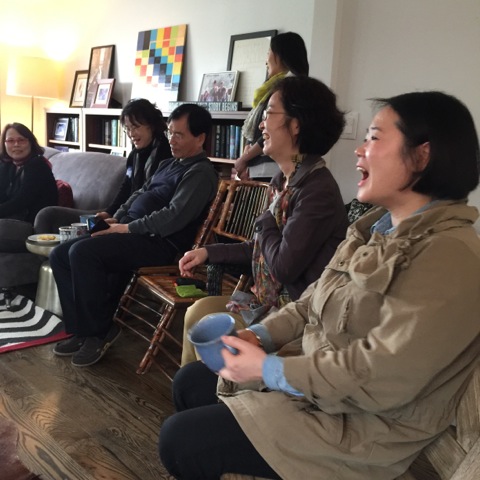
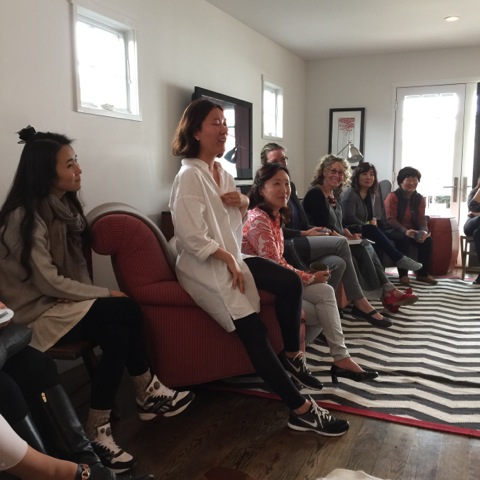
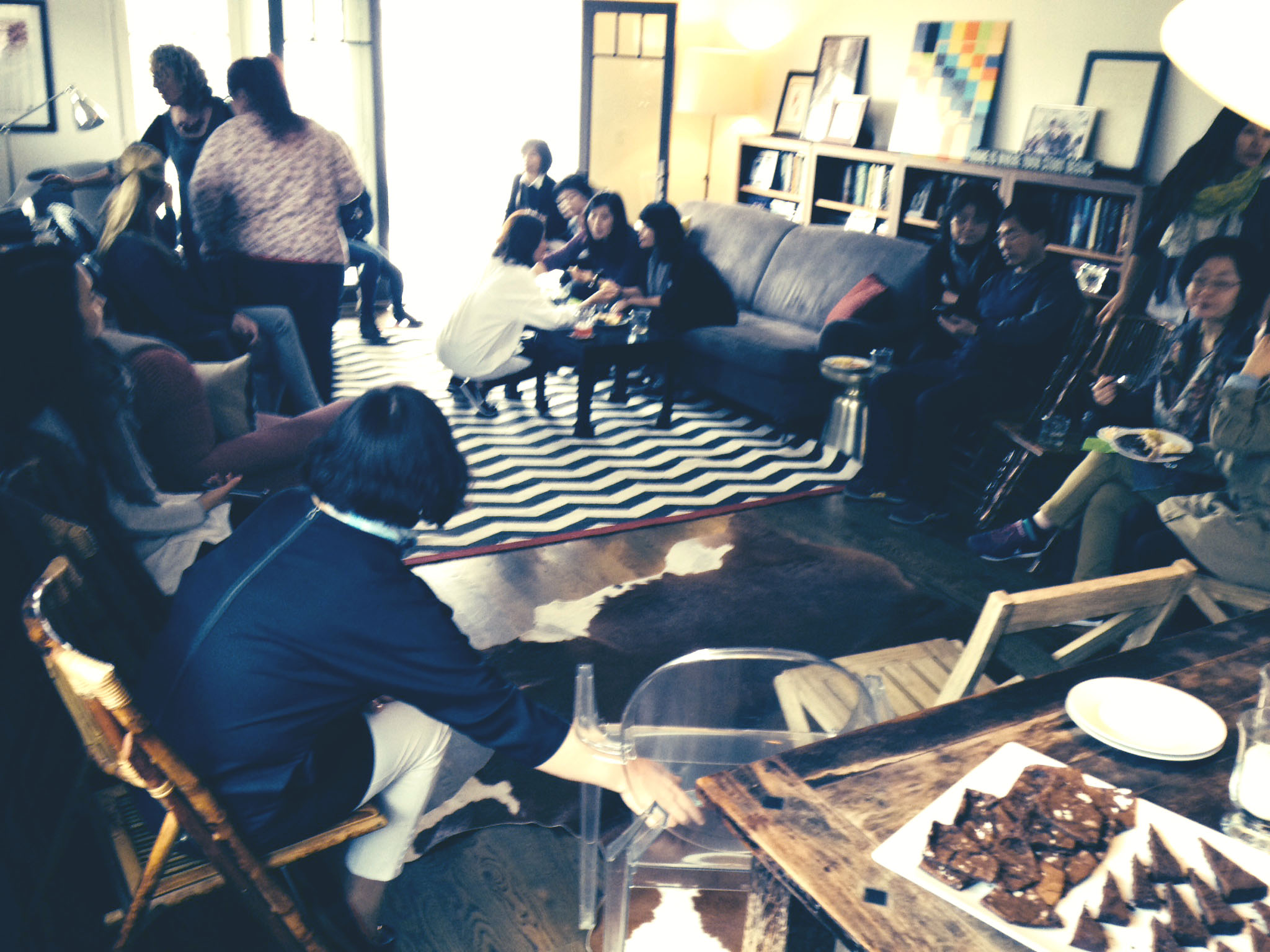
The lunch was hosted at Sarah Reimer’s house. There were 20 visitors from Korea, and from NSW there was Roleen, Kris, Amy, Cindy and Adriana. Parents who attended were Tamy Cohen, Sarah Reimers, Jill Bryman, and Karen Koh (Sean Maher helped set-up but had to leave before guests arrived).
The kids at NSW had questions for our Korean teachers. An English/Korean interpreter helped us talk to one another during this Q&A period.
Q1 from Riley Bryman (that SUPER cute little girl on the EW ;-): “What are you trying to learn from us?”
One of the Korean teachers said “We want to learn how the children & their families all take part in the school, and how they are all part of the learning experience.”
Answers from NSW teachers & parents: “The work building the school’s community starts right when the parents are accepted to the school, well before school even starts. The new families are paired with a “buddy family” to hold their hands & answer any questions they have about the upcoming school year. The new families are invited to attend the Spring fundraiser, have a big family picnic before school starts, and the teachers do home visits with each child’s family. Incorporating the entire nuclear, and sometimes even extended families, into the school experience from the get-go sets the stage for everyone to be involved in the school’s philosophy.” Somebody mentioned the Coffee with Roleens & the grandparent’s lunch, the presentations the teachers put on for the parents to learn about what & how the kids are learning & working together, and the workshops for parents we can attend so the Reggio philosophy is learned & practiced at home as well as at school.
Another Korean teacher wanted to know how conflict resolution is handled amongst the kids.
To this the teachers & parents talked about how most projects at NSW are done as collaborative group projects and that the idea of working together as a team, rather than separately, is ingrained into the kids from the very beginning. Cindy mentioned that their first project when they arrive is always a whole group project that all the kids work on together so they see that working and communicating with one another is important to achieving their goals. We also talked about the documentation committee and how the images capture the children’s connections to one another and by reinforcing those connections, they are able to empathize more with one another. It was also noted that the teachers are sure to jump in and address a conflict well before it escalates, and that they make sure the kids talk through their feelings with each other so it is resolved in a way that they kids can move on feeling good about it.
One of the Korean teachers interjected at that point that she was very impressed that the parents were jumping in and answering many of these questions, and how much the parents knew about the philosophies taught at the school.
Another Korean teacher’s question was: “What happens if children have conflict and how does it affect their parent’s relationships to one another?”.
The teachers and parents answered this by re-iterating that the Reggio philosophy & the NSW philosophy regarding the importance of community is based on the idea that children are citizens of that community themselves, only developmentally they don’t yet have all the tools to navigate all different situations and challenges yet. We believe that “It takes a village”, and that we help each other & each other’s children by supporting them, and not judging them, when they are having a challenging time. Roleen also mentioned again that the teachers always intervene with the children before any problem escalates so rarely is there a conflict so large that it pushes parents to get overly emotional, and that if there is ever a conflict between two parents (which I said I’d never seen or heard of), that they also make sure to resolve it before it escalates. Roleen also said that at the new parent orientation they say “everybody will make mistakes sometimes”, and to set expectations that every year is a new group of kids, a new group of parents and that the best we all can do is to support each other as much as we can while we are there.
Another question from a Korean teacher was “Culturally how do US children differ from Korean children?”.
We answered this with how at NSW at least, there is a lot of acceptance for differing views on how the kids dress, what they look like, their family structure, how their art projects turn out, etc. Differences are celebrated and highly appreciated. This ultimately helps when the kids get together to do group projects. The kids learn to respect each other’s opinions and ideas, and to learn that different input from different people is a good thing rather than having one “Right way vs.dcx vs. wrong way” to how things should be.
The next question was “How long will it take to create a community like this?”
Roleen said it’s an ever evolving process and it changes every year with each new group of families that come and go. Roleen mentioned wanting to step back at some point and having the school run without her daily input and that ultimately it’s the different energy the community brings to the table that will decide how things continue to evolve.
The next question was for Roleen. A teacher asked, “How are you so courageous in your work?”.
Roleen answered “Letting go takes courage. Trusting people is everything.”
Sarah Reimers had a question for the Korean teachers. She asked ” Do you think that one of the reasons why our community is so close is because people in LA, and even in the US in general, have less of a biological family structure around them so they need to create a support network around them instead?”.
The Korean teacher said “The older Korean culture was very much based on community support, but as Korea becomes more industrialized a lot of that community is becoming lost in capitalistic culture. Now people are beginning to see the tragedy of the loss of community and are trying to get it back.”
The next question from the NSW kids was from Penny Jackson. She asked ” Are you looking for a job at NSW?”.
The Korean teachers shook their heads No, and said they like living in Korea.
Finley had a question: “How long did it take for you to get here?”
The Korean teachers said “A LONG TIME. They had to travel to the airport, take a 12 hour flight, then they came by bus & car. It took a whole day to get here.”
(– notes by Jill Bryman)