It was another inspiring night with Patricia Hunter McGrath as she walked us through the key points of The Mind in the Making by Ellen Galinsky. I think there were about 45 people in attendance and it was great to see some NSW parents in the audience as well as our tireless teachers! Thanks to you parents who brought some yummy refreshments. That, along with the touring of the school for teachers and parents from other schools, we proved to be gracious hosts. Gratefully, Laura (Jasper’s mom), has shared her notes from the evening with us. I hope you read through them. They are filled with valuable information and very doable things to do to support the children.
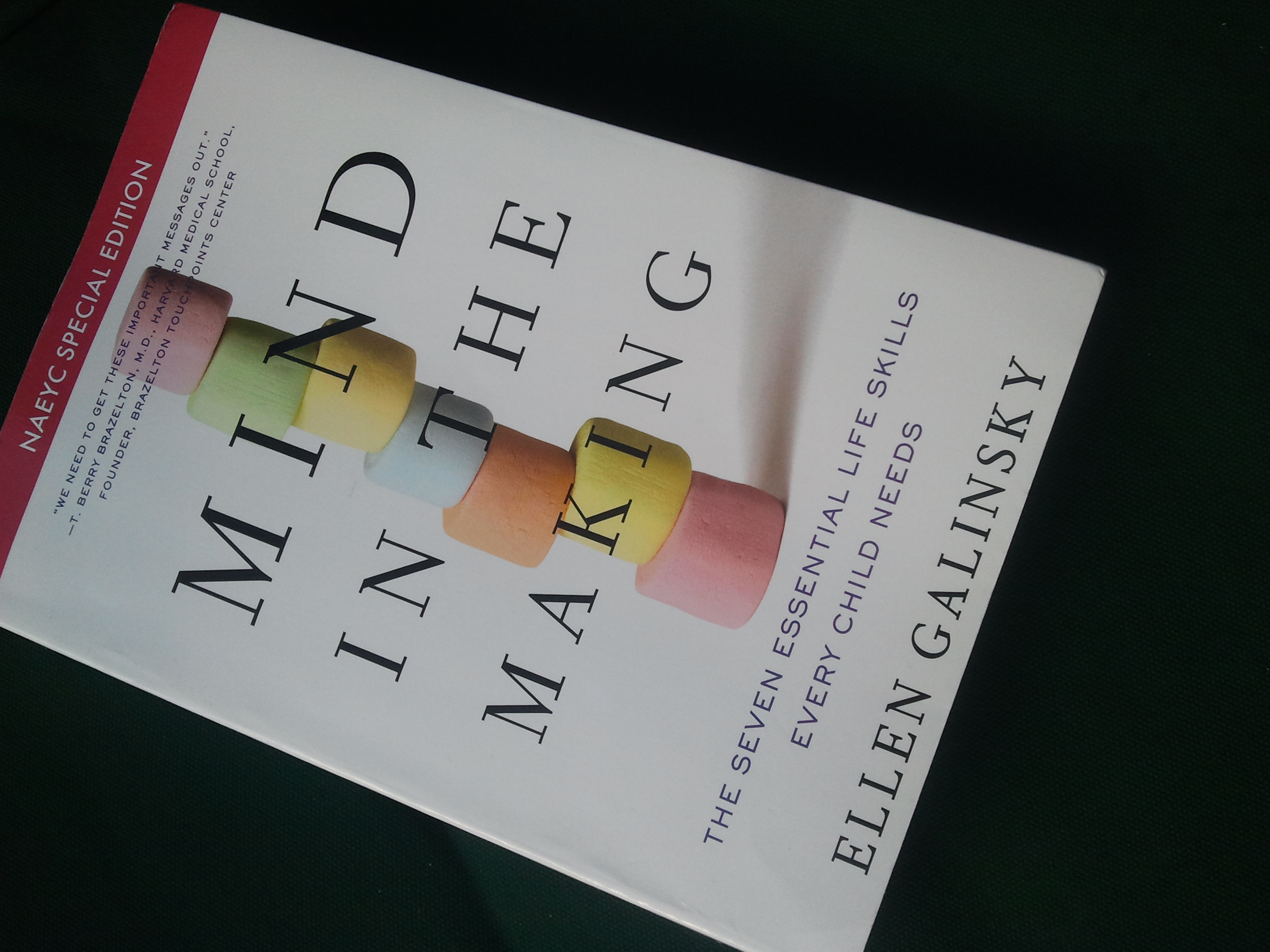
Mind in the Making and the 7 Essential Life Skills by Ellen Galinsky
As presented to New School West 11-17-2011
by Patricia Hunter-McGrath
Introduction:
This book is deeply connected with the Reggio Emilio social-constructionist practice
Once again, it reminds us that the world is busy and how important it is that we slow things down.
Quality interactions with children that just take time.
These days many children are tightly scheduled with “classes” after school, but no class can replace quality time around dinner table having conversations with their parents.
These days, children are not having enough time being bored. If you’re busy, how do you have time to solve problems or invent new things?
A good companion to this book is The Last Child in the Woods. It addresses why people are keeping their children inside more, partially because we are more fear-based, thanks to the 24-hour news cycle.
This connects with the proliferation of media in the home. Research has shown that even if the TV is only on in the background, children’s play is less rich and complex.
We are even resorting to playing DVDs in cars instead of speaking to our kids, but these don’t promote language development.
Here are the 7 Essential Life Skills as outlined in Mind in the Making:
1) Focus and Self-Control
2) Perspective Taking
3) Communication
4) Making Connections
5) Critical Thinking
6) Taking on Challenges
7) Pursuing Life Long Learning
7 Essential Life Skills
1) Focus and Self-control
This includes:
Paying attention
Remembering
Thinking reflectively
Doing what you have to do to achieve their goals.
Research from Columbia University that followed children over time about what skills are important to master, and they discovered there were only three skills needed: Reading, writing and attention skills, i.e. the ability to focus, determine what is important, and pay attention.
To support this at school, the RE approach:
Encourages children to pursue what interests them
Provide a well-organized environment:
One of the most difficult things to do is organization, and children need well-organized environments.
They need to be able to read the environment: if things are thrown into a basket, children can’t organize things. Organization allows children to orient to the world and become more motivated and pay attention to what they’re learning.
Executive function of the brain includes:
Paying attention
Remembering the rules
Managing immediate response to attain goal
e.g. If a child can’t control their emotion, they can’t focus.
Create organized environments with creative materials that encourage creative explorations.
Utilizing simple materials in complex combinations
Research shows that what children need are blocks to live in a 3-d world
If it’s a toy just does one thing, it’s not helpful.
Focus on simple materials that can be used in different combinations
e.g. Light table. Instant place children make connections and children make connections.
Create spaces for quiet time or work. Creates the atmosphere of focus.
Optimal for concentration supports deep learning.
Praise vs. encouragement
Research studied children in two groups of children doing puzzles.
In the 1st group, when the children were doing the puzzles, the teacher said “good job” all he way through
2nd group. You’re working hard at that. you’re not giving up. You’re trying a different way now.
The kids who were encouraged wanted a harder puzzle; children who were praised wanted the easier puzzle.
Children who got praised for being smart, don’t do well in college because they feel it should be easy.
Children don’t need that. If they think things are easy all the time, they’ll cave when things get different.
What they need is resilience. This is what longitudinal research shows.
For toddlers: Don’t lift them up when they are climbing the structure.
Instead observe ad comment. You’re trying to find the next step with your foot. You’re using your knee to get up. You’re working really hard at that. When they get to the top, they’re very proud of themselves.
It’s essential to rethink how we talk to them if we want resiliency for the rest of their lives.
Even young children use complex materials in interesting ways in an environment that encourages focus.
A. Focus
Orienting to the task they want to accomplish.
e.g. Letting put children put their shoes by themselves
Requires time
Concentration and perseverance
Working on things over time
B. Cognitive Flexibility
Ability to switch perspectives or change the focus of attention and flexibly to adjust to different demands
How to support:
e.g. If they love a spoon and you can’t find it, let it be. Or if they left something at home, let it be. Talk about how they wish the toy were in the car. Supports resiliency in life.
If children are never disappointed, they have a hard time with change when they’re older.
In helping too much, we undermine what they do.
C. Working memory
Enables you to hold info in mind while working on it or updating it.
How to support:
Playing games like Simon says.
Reflection meetings in pre-school, “Have to hold what they just did.”
This is how working memory is supported in Reggio classrooms.
Helping children find their voice.
At home:
Memory games support this. Games with cards. Lotto card games. Concentration. Bingo. Simon Says.
Play it in the car because it’s a fun thing to do.
D. Inhibitory Control
Ability to resist a strong inclination to do one thing and instead to do what is most appropriate.
e.g. a child is playing in the sand, and a kid steps on his hand. He wants to slap him but he says, “Hey, you hit my hand.”
Way to support that:
Wait for your turn in a story circle until it’s your turn.
Story games are wonderful for supporting inhibitory control.
Talk through their feelings rather than inhibit their responses.
2) Perspective Taking
Understanding that other people have different likes, dislikes, intentions and thoughts and feelings than you do.
This goes beyond empathy. Goes to figuring out what other people are feeling and thinking and forms understanding of friends, parents, etc.
If children can’t take perspectives, he or she will most likely be in conflict with other people.
Support that in our classrooms and homes
Conflict resolution is a starting point, but need to go further.
Conflict is an opportunity to teach children how to deal with difficult situations. Suggest ways to resolve conflict. Try out solutions and check to see how it’s working.
View children as citizens of the school.
At Branches, children come up with the rules of the school every year. Help schools re-think power structures in the school.
Reflection time: allows time for seeing different points of view.
Support in classrooms: observe interest in baby dolls. Boys and girls love playing with dolls.
New program: Roots of Empathy
By introducing a baby into the classroom, researchers found a decrease in bullying.
Children connect with the baby and this increases empathy.
Put baby on the blanket and just watch her. Why is shaking her foot? Maybe she’s hungry?
Why is she crying? Children try to take perspective of what is happening based on what the baby is doing.
Takes on many executive functions of the brain
Supports cognitive flexibility
Allows you to take consideration of other people’s perspective as well as our own.
3) Communication
Putting aside our own view
Research shows that people whose mother use complex talk to babies allows them to develop a richer vocabulary
Taping family dinner conversations when they were three. People had better literary skills if parents’ talk is about not only what is happening at the moment, but about other things as well e.g. when moon goes down in the nighttime, where does it go? Supporting children reading.
The average time a family spends together during the day is 30 minutes. Dinner conversation is one of the most important ways to support literacy. Sacred family time around the dinner table. Having conversation about how things work.
Communicating well involves exec function
Reflecting goal of what we want to communicate to others.
Skill of determining how to communicate in lots of different ways.
Not just important to communicate verbally but through movement, drawing, building. Different way to communicate ideas and theories. To reflect and dialog about work.
Helps us see details and inspires us and offers us an invitation to support communication and help us share ideas
Invite explorations of color and form
Allows us to look at world in many different ways.
Without imagination, human beings are trapped in their own actuality. By imagining, we’re able to look at things as if they were otherwise.
Difference between children able to get out of poverty. The ones that had art classes had the ability to dream that things could be different
Materials to make new environments. That can reveal and delight, that support individual and group learning. That challenge us and cause anticipation and great joy. Support communication by:
Talking about children’s interest.
Use complex and descriptive words.
e.g. “Watercolors are transparent paints, like a window. Acrylics are opaque, like a curtain.”
Read poetry to children
Maya Angelou
Mary Oliver
Robert Frost
Pack of cards: A poem a night. A child holding a Teddy Bear.
Play with language like children play with blocks.
Simple ways to support communication with your children.
Ask them what they think is going to happen next.
On the first page, ask what is going to happen next.
“Where do you think his mommy is?”
Chapter Books—Can continue the next night
Magic Treehouse Series
My Father’s Dragon
Stuart Little
Winnie the Pooh
4) Making Connections
Putting things into categories
What’s the same and what’s different?
How something represents something else
Finding unusual connections
Simple board games like chutes and ladders make connections.
Creativity is about making connections.
Putting things that don’t go together in unusual and creative ways
Materials that want to encourage balance and that offer suggestions of sorting and patterning.
Encourage making connections.
By offering materials that invite that, children will establish connections.
For example, buttons with a grid
Materials they can build in a hundred and one ways.
Materials that offer questions.
What’s the same and what’s different?
An example of things coming up over and over again.
Rainbows and hearts come over and over with children. What connections are they making between hearts and love?
Children make connections that we don’t see. “Just because the heart’s covered doesn’t mean there’s not love in it,” says one girl about her art work.
Calls on other executive functions like: cognitive flexibility. Making unusual connections with creativity.
Ways to support:
Offering open-ended materials that can be used in different ways:
Games with dominoes and games with numbers.
Using math talk.
Having children draw lists they take to the market.
Conversation and interesting materials: simple: buttons and grids.
Puzzles that can be connected in different ways.
Blockers?
5) Critical Thinking
The ongoing search for reliable knowledge to guide beliefs, decisions and actions
This is also the basis for scientific theories.
e.g. Ramps—What makes a successful ramp?
Working on scientific principles through simple materials.
Like other life skills, critical thinking develops a set course throughout childhood and adulthood.
Draws on executive functions of the brain
How can parents support:
Promoting children’s curiosity
Don’t jump too quickly to solve problems
Help them think about ways to solve problems. Allow children the opportunity to problem solve for themselves.
Family as experts.
Ask children to say what they think about what people said.
6) Taking on Challenges
Taking on difficult things.
In a review of research on stress and children the National council for something important found that: Stress caused by everyday challenges are a positive and essential feature of successful development.
How we help children cope and recover from stress is also important.
Non-verbal communication takes an important role.
Instead of taking a deep intake of breath, when they fall, try to contain reaction and say, “Oh, you fell. Can we help you?”
Anxious parents have anxious children.
Children who have a difficult time taking on challenges have a fixed mindset. Children who take on challenges see their abilities as a growth mindset. The mind is a flexible thing. “You can stretch your rubber band a bit.” “It might be a challenge, but we can work together to solve this problem.”
“I’m not good at it, but I can learn it. It’s not easy for me, but I can solve that problem.”
It is through learning that we realize our own potential. As long as we live, we continue to learn. We need to find ways to be self-directed. We must create life-long learners.
Teachers have to be life-long learners, too. Trying something new. A new class. They realize that everyone continues to learn.
When we replaced the magnatiles with Kapla blocks, the kids were frustrated at the beginning. Then they started building and gaining mastery. One child had a tantrum after the structure he had been working on for 20 minutes fell over. Later, he was working on a very tall structure all day. When it fell down with a crash, he said, “Don’t worry. I can build it again tomorrow.”
Supports resilience. Problem solving increased.
Beware of how you’re reporting stressful experience to your children.
“I’m stressed out about this, but I’m going to work through it.”
“I’m going to think about it, and come up with a solution.” Gives them strategy they can do it again.
Parents who are interfering or alarmists are more likely to increase their child’s stress or anxiety.
Give them positive feedback. When adults praise their effort, more likely to take on challenges.
Help them respond to stresses that our children face. Look at every problem as a wonderful opportunity for children to solve.
Children who want challenges do better in school and life.
7) Pursuing Ongoing Learning
Being a life-long learner.
Early childhood programs have long-lasting effects on children.
Successful pre-schools have one thing in common: Life-long learning community. Every single person in the environment is learning: administrators, parents and children are learning as well.
The importance of children helping children. Children’s skills are nurtured by their friends. If another child can teach it, let the child teach it. The person learning believes they can do it because they’re closer developmentally.
Ways we can support this at home:
Provide direct and involved first hand experiences with children.
Create communities. Work in the garden together. What is going to happen with that seed? Why do you think the worms are in there? How does the worm know where it’s going? Small moments in time that support this. Taking time to understand and understand another person’s perspective.
More information at Reggioinspirations.com
For the layperson, here’s a definition of Executive Function: http://en.wikipedia.org/wiki/Executive_functions