As we planned to relaunch our identity exploration, we gathered inspiration from our professional development work on diversity with Mariama Richards. Mariama, one of the parents of the Cilantro group and the Associate Head of School at Crossroads, introduced Rudine Sims Bishop’s essay, “Windows, Mirrors and Sliding Glass Doors.” Bishop explains how children can see themselves in books and how they can learn about the lives of others through literature.
As teachers, we wondered how the children’s identity panels could act as windows into the experiences of their peers – what they are thinking, who they are, what they know and what is important to them. How could they act as mirrors, reflecting back what they see in themselves to others? To support this, we continued to read the children’s identity panels to the group and encouraged them to notice similarities and differences. We wrote down the categories they identified on a large piece of paper with the intention of representing this information graphically as a next step.
After reading Christoph and Santiago’s ID panels:
Amy: Did you notice anything similar or different? Uma, it sounded like you had a spark when we were listening.
Uma: So he likes to make cards and I like to make cards and Chloe likes to make cards.
Levi: Everybody, I noticed they both have brothers.
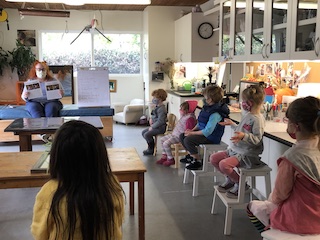
Amy: They both talked about brothers. That’s definitely a similarity and Uma noticed similarities with the children’s ID panels we read yesterday.
Dillon Ray: I noticed that they both like making friends.
All children: Yes, I like to make friends too.
Christoph: Everyone has straight hair except Santiago and I have curly hair.
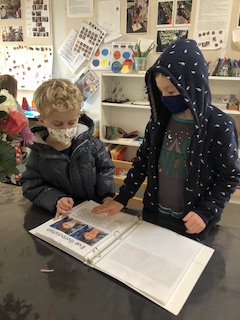
After reading Tallulah’s ID panel.
Cynthia: DId you notice anything that is similar or different?
Mars: I don’t have a dog but Tallulah does.
Everly: I knew about the cat and her favorite is Tangerine.
Elliot: I also know her nana because we had a playdate together and we were next to her nana’s house.
Asher: My grandma used to live in my backyard. When we wanted to go to grandma’s house, she was right in the backyard and we would run down the stairs, open her door, and there she was.
Susan: I noticed that when we heard about Tallulah’s nana, a lot of you started to connect to that idea. Elliot mentioned that he knows your nana and Asher shared about his grandma living in his backyard.
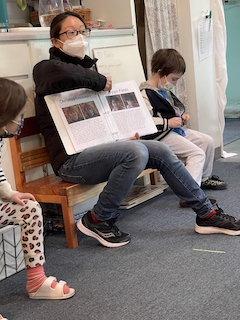
Rufus: I have a grandma too!
Mars: I have Abba. I have my mom that lives in my house but my mom has a mom and she doesn’t live in my house and we call her Abba. Abba is mom’s mom. She doesn’t get toys from her or lollipops.
Mira: I call my grandma, “grandma.”
Elliot: I have a grandma that is my mommy’s mom and she lives in Utah which is really far away so we have to get on the airplane to see her.
Keaton: My mom’s parents are in Utah!
Elliot: Maybe one day we can go to Utah to see them both!
After reading Mira and Rufus’ ID panels.
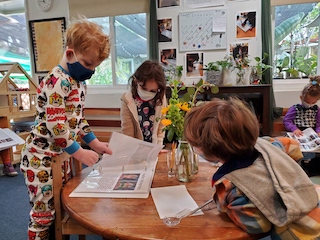
Susan: How are Mira and Rufus similar or different?
Tallulah: Their names are the same – Weiss & Wyss.
Everly: How I communicate is talking like Rufus. I noticed something that is different! The Weiss/Wyss is kinda different. I see “W e i s s” for Mira and then for Rufus, I see “W y s s.”
Cynthia: You noticed the spelling is different even though they sound the same.
Keaton: They talk different and they sound different. And their skin is different.
Elliot: I noticed something different. Mira’s dog is different than my dog.
Mira: Rufus doesn’t have any dogs or cats or puppies. I have two dogs.
Rufus: Because Papa is allergic to dogs.
Elliot: And my Poppy is allergic to cats.
Asher: Mira’s color of the invisible string is rainbow. I remember Rufus is connected to Jack and Miles.
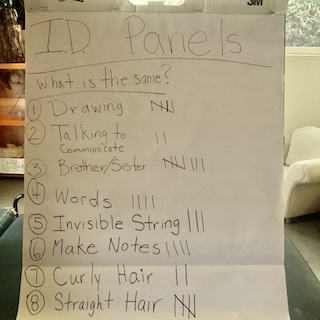
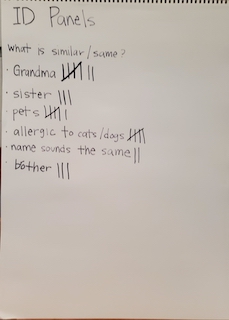
We are making it an intention to really slow down and create space for the children to identify categories of difference and similarities as they reflect on the ID panels. By working towards visually representing this information through different mediums, we hope to create a tangible experience that walks them closer to making sense of these abstract concepts and helps them to understand each other better. We also hope that it will help them celebrate our differences and our similarities, how all of these characteristics make them who they are and all of these collective identities create a diverse community.