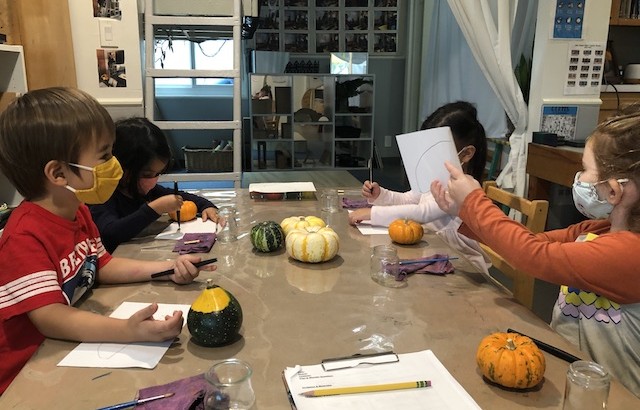
In the West Wing, many of our beginning experiences with drawing and painting are centered around the joy of pure exploration: How do I feel when my brush moves across the paper? What happens when these two colors play together? What emotions can different colors bring? As the children become more familiar with paint and line tools and learn how to use and care for them, the teachers support the children in becoming more intentional in their use of the materials. We begin to move from the abstract to the representational. As Carlina Rinaldi has explained, “The teacher’s job is to engage in ‘relational creativity’ with the child that both revels in the child’s creativity and stimulates the teacher’s own creativity to find ways to help the child observe, analyze, interpret, and build theories.”
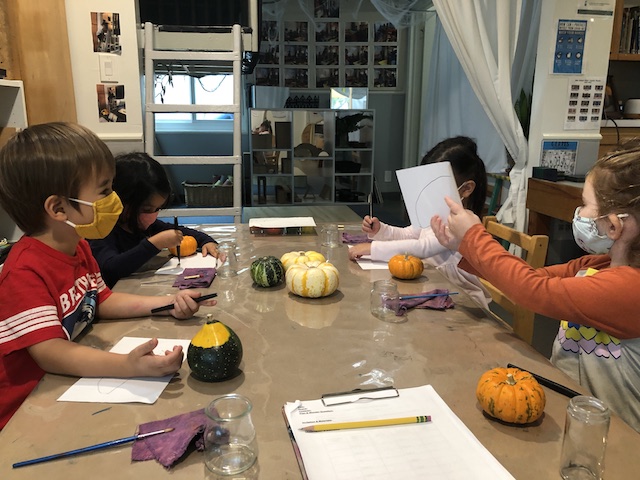
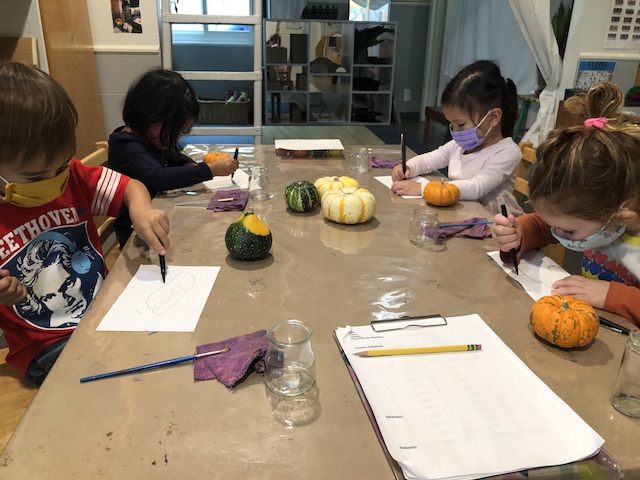
For the past couple of weeks, the children in the West Wing have been introduced to the concept of observational drawing: drawing what they see. The Cilantros and the Dandelions began by looking at some of the smaller pumpkins and gourds that families have brought into the classroom. Each child chose one item and placed it directly in front of them.
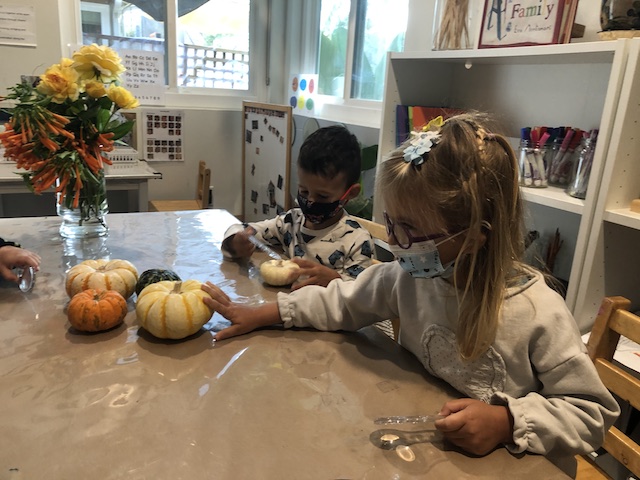
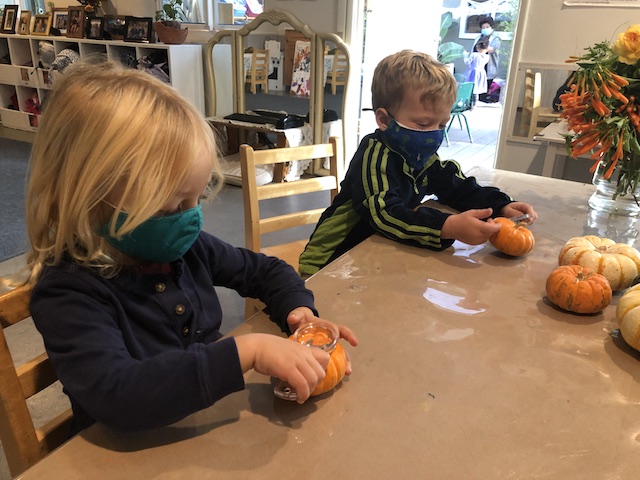
Dana: Let’s start by talking about what we notice and observe.
Eddie, holding a pumpkin: It’s a circle.
Zoe: Mine is a circle.
Arya: Mine is a circle.
Emma, holding a gourd: No, mine is not. It’s a pear. Like this.
Emma uses her finger to trace the shape of a pear, narrow at the top and wide at the bottom.
Dana: Oh, that’s a really good way to practice drawing the shape. Let’s all use our fingers to trace the shapes that we see.
Dana: Now that we practiced drawing the shapes in the air and on the paper, we are going to draw the shape with our pens on the paper. Remember, we are drawing what we observe.
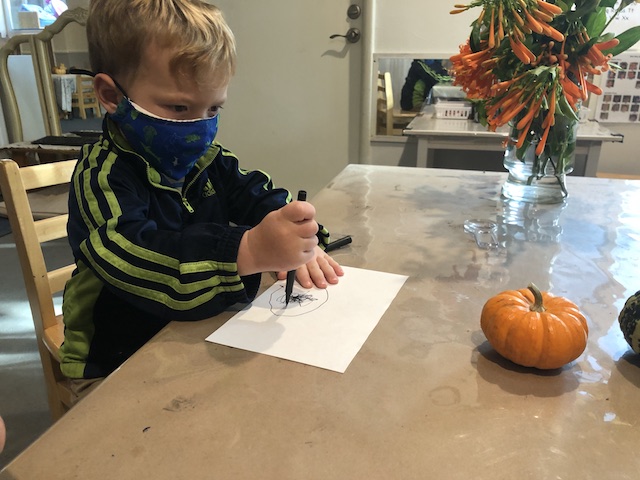
The children use the felt-tipped pens to draw circular shapes on the paper. Emma then adds a smiley face to the middle of the circle, along with four lines extending from the sides.
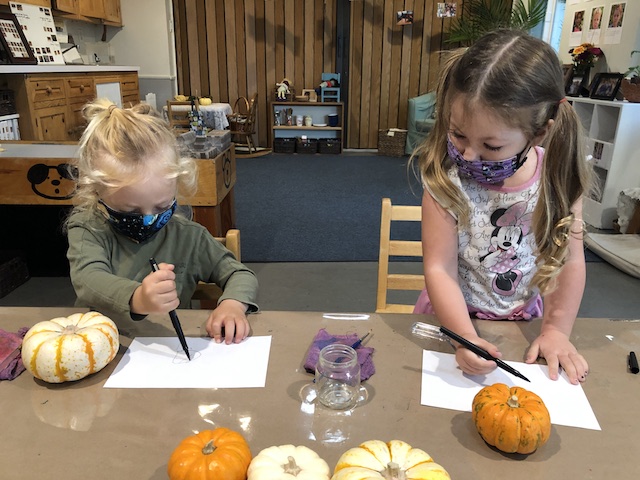
Emma: Look, it’s a person!
Dana: Let’s take a closer look at the pumpkin in front of you.
Emma: But I’m using my imagination!
Dana: Right now, we are using our observational skills. We are drawing what we see with our eyes.
Emma: Oh, okay. There’s no face on this pumpkin then. Only this part.
Zoe: The stem.
Arya: Mine has a stem.
Zoe: It’s like a line coming up. I can draw it on the pumpkin.
Emma: Me too. Here’s the stem!
Once we finished drawing the outline of the shapes with the flair pens, the children added color with tempera paints. (The Dandelions had mixed colors earlier in the week, also using the pumpkins and gourds as inspiration for their palette!) We really slowed down the process by using the magnifying glasses to take a closer look at the colors on the pumpkins and gourds before picking up brushes.
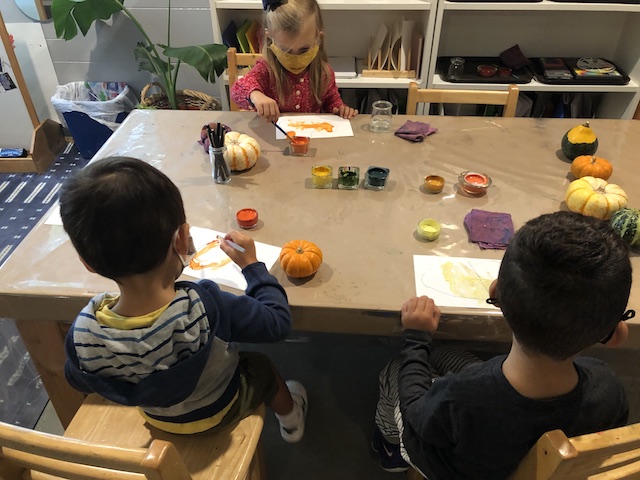
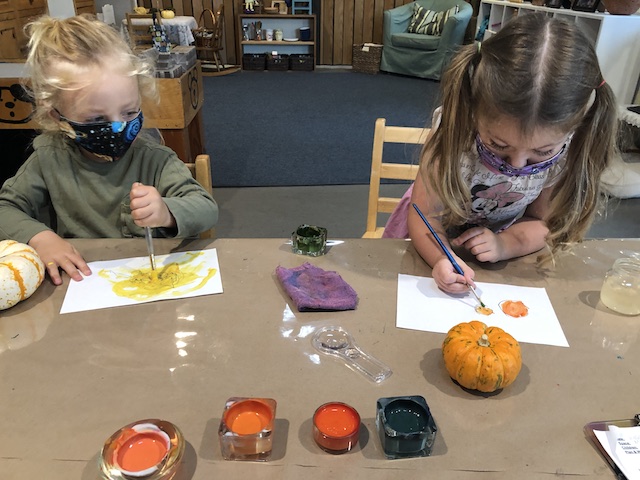
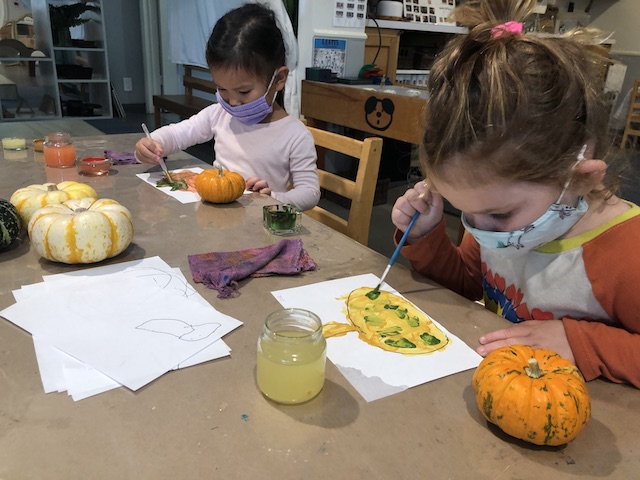
Evyn: What’s this? Look at this, teacher Dana!
Dana: What are you noticing?
Evyn: I’m noticing this green on the pumpkin. I’m going to add green on my painting.
Leon: Oh!
Dana: Leon, what are you noticing?
Leon: I don’t know.
Evyn: There’s a lot of orange on that pumpkin, Leon!
Leon: Oh, yeah. Lots of orange.
Evyn, picking up a roundish green gourd: This one reminds me of a kiwi! They are all different!
All of the children in the groups took a turn at the table for their initial experience. After each experience, we took the work back to our reflection meeting.
Dana: I’m wondering if Eddie, Leon, or Evyn wanted to begin sharing what we were working on at the mini studio this morning.
Eddie: Painting. Using orange and green.
Evyn: I drew a circle because we were making pumpkins.
Dana lays out the pumpkins and the papers on the ground and holds up one paper and showing it: I’m wondering if we can tell which pumpkin Evyn was observing?
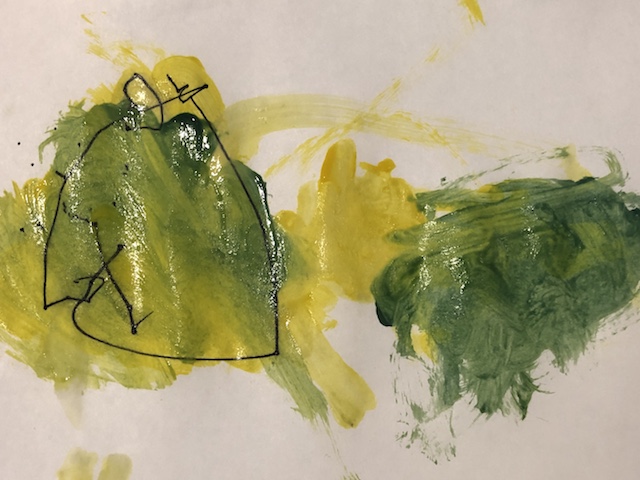
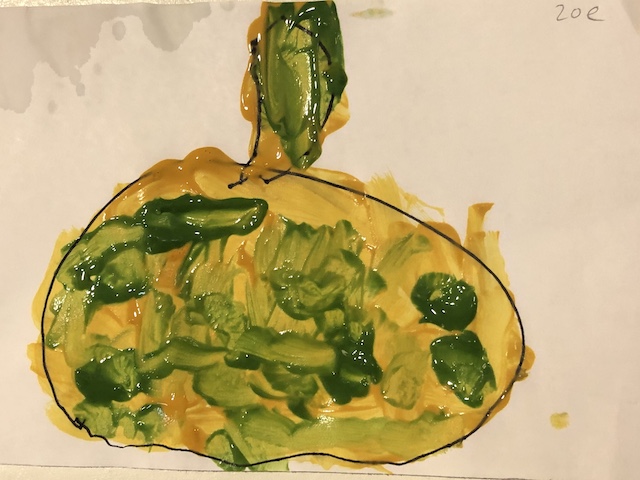
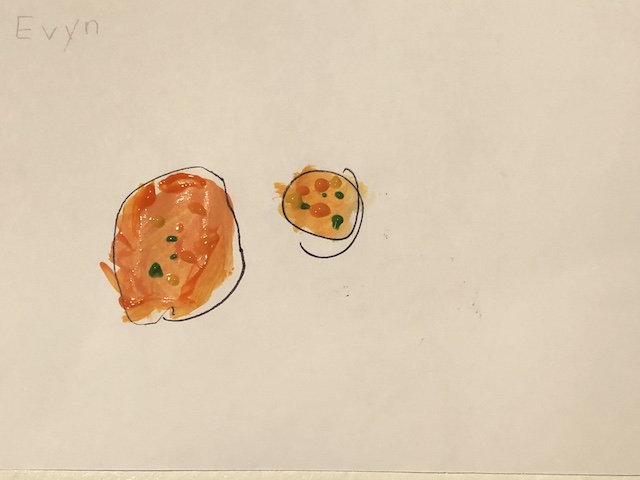
Marcel: I picked the one with orange and green.
Evyn: The orange one with lots of green on it!
Dana: Yes, same, same! This picture matches this pumpkin.
This matching game is a fun way to share the work of the small group with the larger group; importantly, the game also acts to reinforce the idea that observational drawings can convey information and meaning to others who weren’t part of the original experience. Marcel wasn’t at the Mini Studio table that day, and he was still able to understand exactly which pumpkin Evyn was drawing because of her attention to the shapes and colors of the pumpkin. When drawing becomes a language with shared meanings, we find new ways to communicate, build theories, and connect.