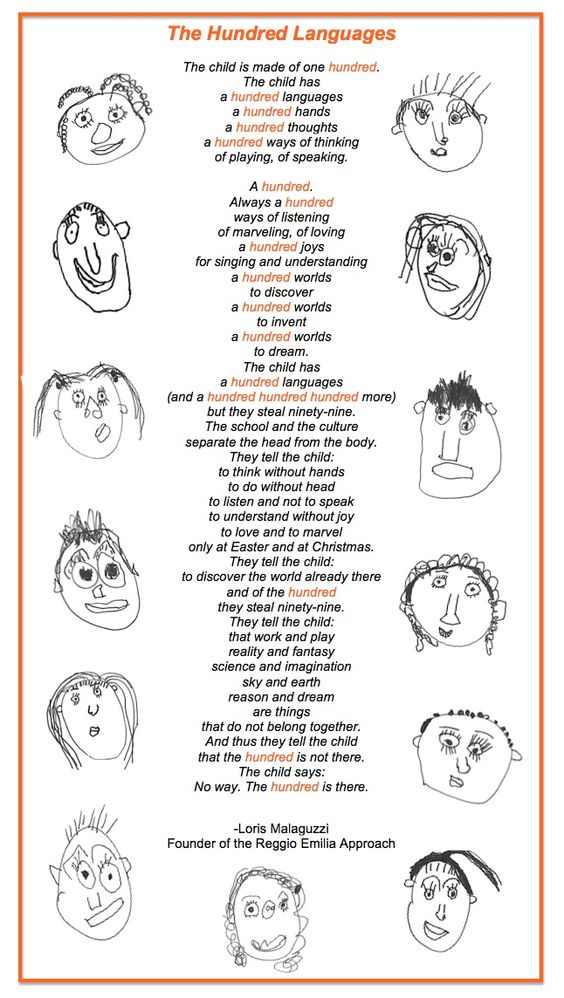
As we begin each school year, we reflect on our values and continue to be inspired by this poem “The Hundred Languages of Children” by Loris Malaguzzi. As educators, we believe that children come to us full of rich intelligences. Our responsibility is to offer experiences that foster an avenue for them to make their learning and knowledge visible. We start by creating an environment where work can be revisited and last over extended periods of time.
Knowing that children have complex ways of knowing the world around them and layer their theory making, we need to consider the role of materials beyond making art or crafting but as mediums to test and modify their thought processes. In addition, we value a social constructivist approach to learning that incorporates peer scaffolding and collaboration. As we explore together you will notice the children working on community pieces where individual parts are contributed to a whole or added as layers to the continuing work. With each material, we start with our hands as the most important tool, then incorporate tools and techniques that are specific to each medium.
With the intention to bring comfort to the children through familiar routines in the school environment, the Dandelion teachers’ initial activities in the Front Yard included paint exploration in small groups. Considering that the children’s bodies need to keep a physical distant, we wondered what kind of interactions the children would experience together while physically apart?
Honoring the energy that holds us together while apart, is one of our West Wing strategies to guide the children’s learning within the context they are living. Like the children, teachers are also exploring this new approach to learning together. We believe that searching for connections between children, children and adults, and children and our environment will bring us together in this learning project.
Our setup included primary colors in large bottles waiting to be squeezed by the children, along with paint brushes and rollers in addition to hand painting. Teachers intentionally layed down one large piece of paper with the purpose of inviting a sense of community. With just one bottle of each color, the children needed to reach out to their peers for the color they wanted to mix next. Negotiating, communications and turn taking is practiced along with waiting. These learning exchanges are facilitated by the teachers mostly in the beginning as part of our school culture. We guide children to use their voice to ask for what they need and to listen to others’ requests. We sanitize their hands and bottles to enable these moments to happen.
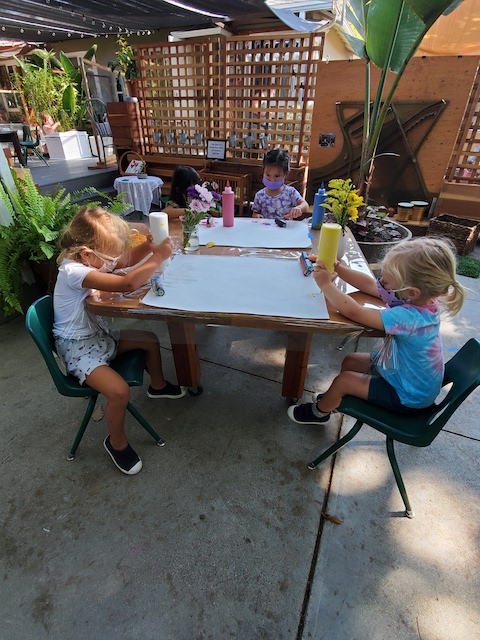
Zoe: Can I have the white?
Evyn: Can you give me some white?
Spencer: Can I have some blue?
Emma: Can I have the white after you?
Cary: I’m done with the blue.
As the paint exploration continues with the children squeezing paint colors, rolling, and spreading it with their hands or all over themselves and on the paper, we could hear them thinking out loud what was on their minds in these precise moments.
Cary: Painting a purple airplane and blue train.
Ana: Spider Man
Emma: Painting purple
Eddie: All the colors.
Marcel: You can spray the fire house.
Zoe: Mom and daddy are at work but Isela is going to pick me up.
Cary: Blue.
Spencer: It’s brown now.
Flora: How did you make brown?
Spencer: I don’t know. I just got all the colors.
Ana: I painted a little hamster. Hamsters don’t bite me. Hamsters remind me of eating flowers.
Cary: Green, purple.
Emma: (Processing her school experience) Daddy is going to work. Mom takes care of baby. Daddy is back. They have a house. Here is a slide and a ladder and this is New School-West. Okay, It’s time to go to NSW. No, no, no. Okay. Fine.