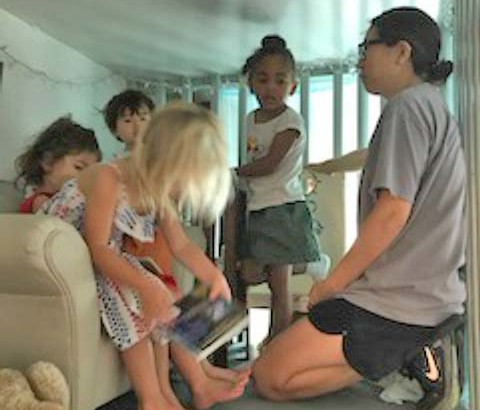
Teacher language, or the pragmatics of language, is a constant mystery to parents. How do teachers do it? How do you facilitate arguments, or engender respect, or just, ‘how do you get my kid to do that?!’ Here is a typical interaction in which Teacher Susan uses the body language, tone and words that will become second nature to the community in the West Wing.
Lola singing loudly
Coco in the crib: You’re waking me up.
Arrow and Kayden begin to get upset with Lola.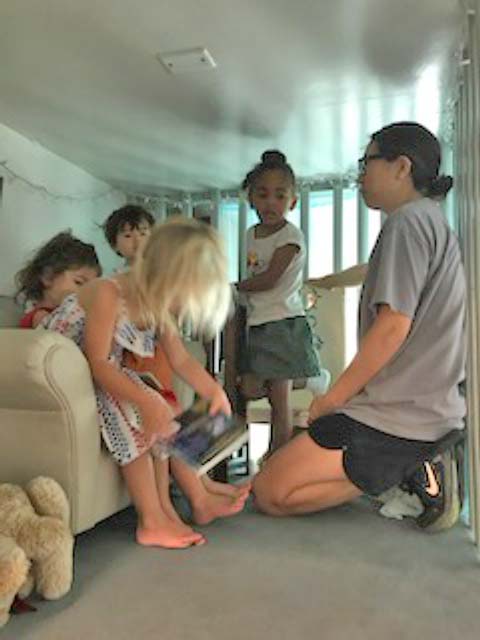
Teacher Susan giving the group a different perspective: Lola, are you singing the baby a lullaby?
Lola: Ya.
Lola wants to be the baby in the crib where Coco is. Susan facilitates a plan.
Susan: Coco, when you are done being in the crib, Lola would like to get in.
Kayden: I want to get in.
Susan: So the plan was that Kayden goes in after Coco, then Lola goes in after Kayden.
The children all confirm the plan. Coco gets out and Kayden moves to go in but Lola goes in instead.
Susan: Lola, pause your body. We had a plan.
Susan, Coco, Arrow, Kayden, and Lola repeat the plan, using the same language consistently until everyone has had a turn.
By saying “Pause your body”, the teachers reserve the word “Stop” for emergencies. Bringing attention to one’s own body by thinking about it and commanding it to pause also links the emotional drive to the physical expression and causes reflection to occur. In a state of reflection, a plan can be made collaboratively. The children make the plan so that they have agency in its design and are not asked to simply follow an arbitrarily set rule. This ownership of the plan brings responsibility to the designers for its implementation. It’s not a magical cure, it’s consistent repetition that builds a trust for these words and actions to have meaningful results for children. -Kristin