During a morning drop-off time, Teacher Jen and Zoe Foxley (Gus, EW) engaged in a short discussion about the documentation and progression of Loveland. They reviewed the children’s words about “bad guys” and the jail that was on the outskirts of Loveland. Zoe began to share her perspective from a much bigger lens. As it was quite clear that Zoe had so much insight and information, Teacher Jen invited her to share her thoughts in a whole staff meeting.
Zoe has a MSW, has interned at the Dorothy Kirby Center, and is highly involved in her family’s foundation which focuses on Criminal Justice Reform. She gave us all a perspective about our society and facts about our jail system of which most of us were not aware. As she shared stories of the lives of those who have been incarcerated and of those who have been affected, it highlighted her words, “Those who hurt people are hurt people and those who are healed, heal people.”
And though this conversation didn’t directly inform our work with the children, it certainly did indirectly. How do we, the adults and our society, perceive “bad guys”? As we were provoked to ‘see’ the person instead of the person’s worst decision, we considered ways of supporting the children to do the same.
One of our strategies for helping children take a deeper look was to introduce Reverse Chronological Story-Telling. This is where we have a small group discuss the plot and they have to figure out a beginning and an end. This way they consider context, possibilities, and choices made that produce specific results. They are given pictures of the characters experiencing different emotions, a setting, and time of day. They collectively name them and create their connections among them. This has helped them see how each of the characters has a backstory. This perspective taking game supports them in basing their judgments on more than a person’s singular action.
Teacher Jen: What happened before they were fighting?Aiden: They were happily playing.Henry: We have to connect them together.Leah: And these are sisters. And they are mad at each other.Mila: And those are brothers.Aiden: This one is feeling bad for his brother because she took it from him.Henry: So where does it end? Was there a teacher there when it happened?All: NoThe children take a moment to play out the characters’ (Kate and Bill Oliver) conversation. “Kate walked up to Bill Oliver to say ‘you’re a meanie’.”Leah: Sometimes brothers are mean to each other.Teacher Jen: So you could picture that happening?Aiden: No, not at school. He should feel bad that someone took something from his brother.Leah: My sister usually tattles on me. My sister doesn’t really share anything.Aiden: Yes, but he’s his brother.Teacher Cindy: Mila, you have a brother.Mila: He always says I’m mean.
“He says I’m always mean.” – Mila
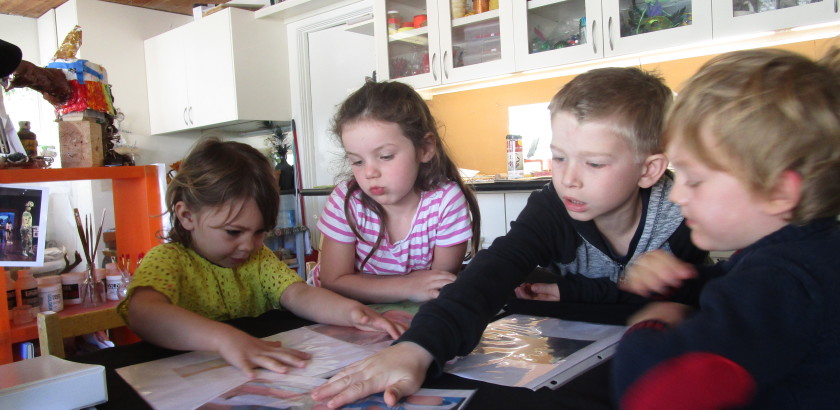
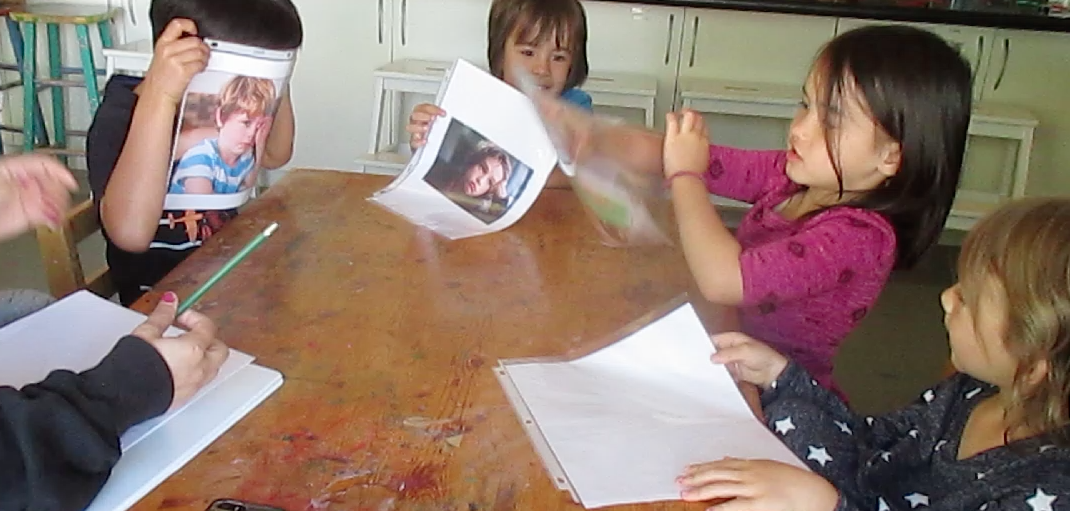
Though some characters were more at fault for the disagreement than others, they were not labeled as ‘bad’. The children in some way personally connected to them as they put the characters photo on their own face and act out their feelings and responses. This gave them an opportunity to feel and think the way the character might have thought and felt. Nobody is labeled as bad because each character is understood for having the feelings they were having. Kristin