The EW teachers are focused on the children becoming a caring community. Though many of them have the tools to label their emotions and talk through their conflicts, their actions show a disconnection to their words. After the teachers shared their observations with each other, they decided to focus efforts on helping the children with perspective taking. This way, they reasoned, the children would embody the feelings they were discussing. They started the conversation with, “What is loving?” From this point, they followed the children’s discussion about love and other emotions and now find themselves very curious about a place the children have started to create. A place called, Loveland.
During a Reflection Meeting, the children collectively created a map of Loveland using recyclable materials. They started by creating roads, an ice cream cart, the love machine, a school, hotels with pools, a garden, and then a jail. As the jail is placed on the edge of the map, the children discuss their thoughts.
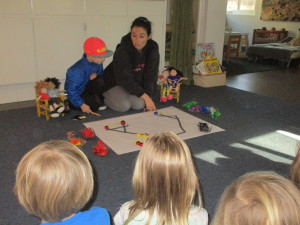
Henry: It’s (the jail) a long way for them to run into town.
Theo P.: There will be a sign that says, “Loveland is this way” but actually it will go to the lava.
Ozzie: And go back into the jail.
As Mila adds the train, the children become concerned about how close it is to the jail.
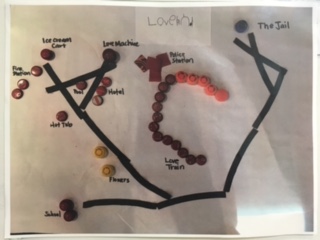
Leah: It’s almost to the jail.
Theo P.: If robbers get on the train, the robbers will steal the money on the train.
Ozzie: No, that would be good because there is love on the train and robbers don’t like love.
Henry: Sometimes they are nice, but really not.
Ozzie: Robbers are just people who make bad choices.
India: Why does there have to be a jail?
Miro: What if there are bad guys stealing money and there are no police?
Aiden: If there are bad guys or teachers that get mad and have to go to jail.
Gus: There has to be police in every city. Because there is bad guys.
Loveland is an opportunity to learn what the children think is an ideal community. They have created a code of conduct where children are allowed to feel any emotion. Adults, however, are not allowed to feel even the smallest bit of anger because “they know more.” Also, the children created a system that keeps them safe from “bad guys/robbers” with a jail and a love machine that tricks robbers into being changed into babies.
As teachers, we know their line of thinking is completely age-appropriate. We are asking ourselves: How can we help the children see the world through a “we” rather than an “us versus them” lens? Can we help create a grey area in this land of black and white? How does it feel when we feel angry with someone we love? How does it feel for the person who made a ‘different’ choice?